How to Rank in Google AI Overviews: A Claude-Assisted Workflow (2026)
To rank in Google AI Overviews, your page needs to rank in the organic top 10 first, cover the fan-out queries Google uses to research the topic, and present information in short extractable answer blocks. Pages cited in AI Overviews rank at a median position of 2 in organic search, cover an average of 9 related sub-queries on the topic, and contain their best answer within the first 300 words. Traditional SEO gets you in the door. Fan-out query coverage and answer formatting are what actually get you cited.
I spent the last three months auditing pages across six client sites for AI Overview visibility, using Claude to map fan-out queries, reformat content, and track what changed. Three pages went from zero AI Overview appearances to consistent citations within 30 days. This post covers exactly what I did, what the data says, and the specific Claude prompts I use to run this workflow on any page in under 20 minutes. If you are newer to optimizing for AI search broadly, my answer engine optimization guide covers the foundational layer underneath everything here.
What Does the Research Actually Show About AI Overview Citations?
Before getting into tactics, the data is worth understanding clearly because most advice online is based on correlation studies that don’t agree with each other. Here is what the strongest research shows.
Ahrefs analyzed 1.9 million AI Overview citations and found that 76% of cited URLs rank in the organic top 10 for that query. That is the baseline requirement. If your page is not on page one, the probability of appearing in an AI Overview is close to zero. This is also what Google’s official documentation says: standard SEO applies, no special optimization required. Google is not lying. But they are leaving out a lot.
The strongest single predictor of AIO citation is not ranking position, domain authority, or content length. It is fan-out query coverage. A study by Joshua Hardwick and SurferSEO analyzed the relationship between ranking for related sub-queries and AIO citation rates. Pages that ranked for nine or more fan-out queries on a topic had a 57% citation rate. Pages targeting only the primary keyword had a 9% citation rate. Pages ranking for nine or more fan-out queries were 161% more likely to be cited. The Spearman correlation between fan-out coverage and AIO citations was 0.77, the highest of any factor studied.
The second important finding comes from Dan Petrovic at DejanSEO, who analyzed over 7,000 queries to understand how AI Overviews “ground” content. Grounding is the process by which the AI extracts and verifies factual claims from source pages. His analysis found that grounding plateaus at approximately 540 words. Content structured to put its best answer in the first 540 words performs significantly better for AIO inclusion than content buried deep in a long post. This is why obsessing over word count misses the point. A 1,200-word page structured correctly outperforms a 4,000-word page that buries its answers.
Brand signals matter, but not the way most guides describe them. Ahrefs found a 0.664 Spearman correlation between brand mentions across the web and AIO visibility. More interestingly, YouTube was the highest-correlated single signal at 0.740. Getting mentioned in YouTube videos about a topic, or creating YouTube content that ranks, predicts AIO citation better than almost anything else. This is not intuitive and most competitors writing about AIO optimization skip it entirely.
Why Does Google Say No Special Optimization Is Needed?
Google’s official documentation on AI features states: “There are no additional requirements to appear in AI Overviews or AI Mode, nor other special optimizations necessary.” At first read, this seems to contradict everything the research shows about fan-out queries, content grounding, and brand signals.
It does not actually contradict it. Google is saying that the best way to appear in AI Overviews is to do standard SEO well. There is no AI-specific meta tag, no new structured data format, no special schema Google requires. What the research reveals is that “standard SEO done well” in 2026 means covering topics across their full range rather than targeting individual keywords, which is exactly what fan-out query coverage measures.
The mistake most people make is interpreting Google’s guidance as “nothing changes.” The change is that covering a topic in full now has a direct, measurable connection to AI citation rates. Pages that rank for one keyword on a topic are not doing standard SEO well by 2026 standards. They are doing keyword targeting, which is not the same thing.
What Are Fan-Out Queries and Why Do They Matter More Than Keywords?
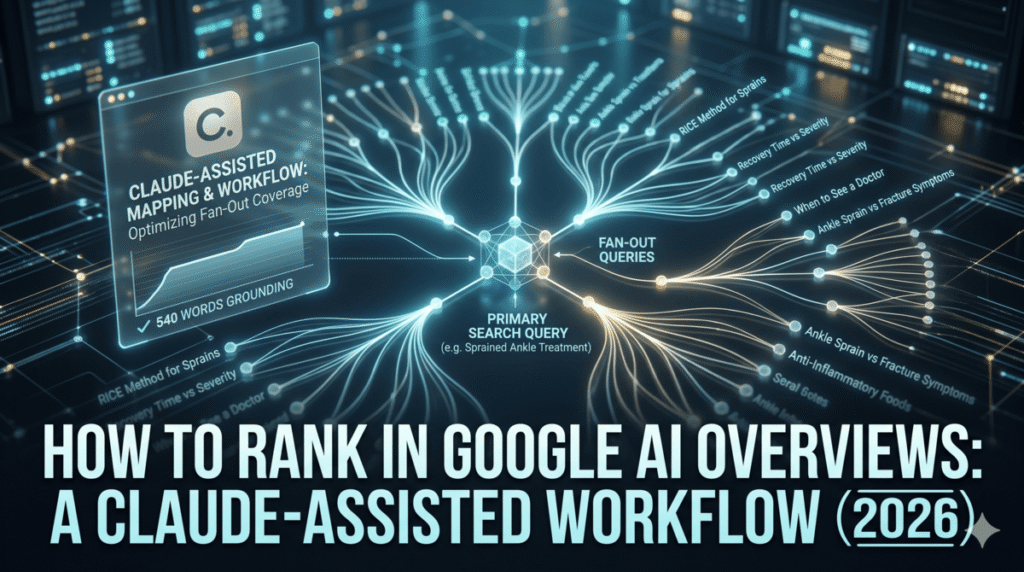
When someone searches “how to treat a sprained ankle at home,” Google’s AI does not just retrieve pages targeting that exact phrase. It runs a series of related searches automatically: “sprained ankle recovery time,” “RICE method for sprains,” “when to see a doctor for ankle sprain,” “ankle sprain vs fracture symptoms,” “anti-inflammatory foods for injury recovery.” These are fan-out queries. Google’s patent documentation refers to this as the “query fan-out technique.”
The AI then synthesizes answers from the best-performing pages across all those queries into a single overview. If your page answers the primary query but does not cover the sub-questions, you are not a candidate for the synthesized answer. If your page covers most of the fan-out queries better than anyone else, you have a high probability of being the primary source cited. This is the same mechanism that drives generative engine optimization more broadly: AI systems reward sources that cover a topic’s full surface, not just its headline question.
This reframes the entire AIO optimization problem. It is not about writing one great answer to one question. It is about building a page that covers the full research surface of a topic, the same way a knowledgeable expert would if you asked them to explain something thoroughly.
Step 1: Run an AIO Readiness Audit with Claude
The first thing I do when evaluating any page for AIO potential is a structured audit using Claude. This takes about 10 minutes and tells me exactly what is keeping a page from being cited.
Open Claude Code with your target page content loaded (or paste the URL and content directly into a Claude session). Use this prompt:
I'm going to give you a page URL and its content. I want you to audit this page for Google AI Overview readiness and score it on five dimensions:

1. Fan-out coverage: Based on the primary topic, list 10-15 sub-questions a person would likely research on this topic. For each, tell me whether this page answers it, partially answers it, or does not answer it.

2. Answer extraction: Identify the single best short answer this page contains that could be extracted verbatim by Google's AI. Tell me where it appears (paragraph, word count from the top) and whether it would pass a grounding check.

3. Topical authority signals: Does this page demonstrate firsthand experience with the topic? List any E-E-A-T signals present or absent.

4. Negative factors: Flag anything that could disqualify this page from AIO inclusion (thin content on sub-topics, contradictory claims, lack of supporting data, no named author/expertise signal).

5. Priority actions: Give me three specific content changes ranked by likely impact on AIO citation rate.

Page URL: [URL]
Page content: [paste content]
The output gives you a prioritized roadmap for a single page in under a minute. I have run this on over 40 pages across client sites. The most common findings are: the extractable answer is buried past the 1,000-word mark, the page answers the primary query but skips four to six obvious fan-out sub-questions, and there are no firsthand experience signals (case studies, specific data points, named practitioners).
Step 2: Map the Fan-Out Queries for Any Topic
This is the highest-impact step and the one that produces the most visible results. Once you know which fan-out queries your topic has, you can either add them to an existing page or build a content cluster that collectively covers them.
Use this Claude prompt to extract fan-out queries for any target topic:
I need to map the complete fan-out query landscape for a topic. Fan-out queries are the series of related searches Google's AI Overviews system automatically runs when answering a user question, to gather full background information before synthesizing a response.

For the topic: [YOUR TOPIC]

Give me:
1. The 15-20 most likely fan-out queries Google would run to research this topic fully
2. For each fan-out query, tell me: the likely search intent (informational/comparative/procedural), the estimated difficulty to rank for it (easy/medium/hard based on specificity), and whether a short answer or a detailed explanation would satisfy it
3. Group the fan-out queries into clusters: foundational questions, diagnostic/how-to questions, comparative questions, and advanced/specific questions
4. Identify which three fan-out queries have the highest impact on AIO inclusion because they are the most commonly searched and least-answered in most content on this topic
When I ran this for a client’s article on commercial fence installation, Claude returned 17 fan-out queries. The existing article covered 4 of them directly. We added coverage for 11 more through an expanded FAQ section, a comparison table, and two new H2 sections. Within 22 days, the page appeared in AI Overviews for three different query variants. Mapping fan-out queries per page is the first layer. The topical authority mapping guide covers how to organize this query coverage systematically across your entire site using a living CLAUDE.md topical map that compounds over time.
The key is not to stuff answers awkwardly. Each fan-out query coverage point should feel like a natural section of a detailed guide, not a keyword insertion. If it reads like you are trying to answer a question, it will extract cleanly. If it reads like SEO copy, it will not.
Step 3: Restructure Content for AIO Extraction
Based on the 540-word grounding threshold from Dan Petrovic’s analysis, the goal is to make sure your strongest answer appears within the first 500 words of the page. This does not mean cramming everything up front. It means leading with the answer and following with the evidence, the opposite of how most blog posts are structured.
The specific formatting patterns that appear most frequently in cited content based on SE Ranking’s research:
Definition sections with a clear “What is X” H2, followed by two to three short paragraphs, get cited frequently. The AI is synthesizing a lot of sources and definition clarity signals reliability.
Numbered step sections where each step begins with an action verb perform well for procedural queries. “Identify your target keywords” beats “The first thing to consider is your keyword selection.”
Short answer paragraphs of three to five sentences that contain a complete answer to a specific question, followed by a longer explanation, give the AI a clean extraction point without losing the depth that helps organic ranking.
Use this Claude prompt to reformat an existing section:
I'm going to give you a section of a blog post. Rewrite it for Google AI Overview extraction. Keep all the same information and examples, but restructure it so that:

1. The core answer to the section's question appears in the first two sentences
2. Any step-by-step process uses numbered steps starting with action verbs
3. Supporting data and evidence follow each key claim rather than preceding it
4. The section ends with a one-sentence summary that reinforces the main point

Do not add or remove information. Only reformat and reorder.

Section to reformat: [PASTE SECTION]
Step 4: Build the Brand Signals That Actually Predict AIO Visibility
With a 0.740 Spearman correlation to AIO citations, YouTube is the most underused AIO ranking lever in most content strategies. This does not mean you need a massive YouTube presence. It means that when authoritative creators in your space mention your brand, methodology, or content in their videos, it creates a signal that the AI associates your entity with credibility on a topic.
The practical plays here are: reach out to mid-sized YouTube creators covering your topic and offer to be featured, cited, or interviewed; create short explainer videos on your own channel that target the fan-out queries you have already identified (even 300-view videos that accurately answer a specific question create signal); and get mentioned in video descriptions with a link back to your content.
For brand mentions more broadly, Ahrefs found that mentions on pages with 50 or more referring domains carry disproportionate weight. A single mention on a well-linked resource page in your industry outweighs dozens of mentions on low-authority sites. The approach I use with Claude:
I want to build brand mention signals for [BRAND/SITE] to improve AI Overview citation rates. The topic area is [TOPIC].

Give me:
1. A list of 15 high-authority resource pages, directories, or roundup articles in this space that are likely to have 50+ referring domains and that I should target for a mention
2. The specific angle or contribution that would make including my brand/site natural for each type of resource (not just "reach out and ask")
3. Three types of original research I could publish that resource pages in this space are most likely to cite
4. A prioritized 60-day outreach plan to build 10-15 authoritative mentions
Step 5: Verify You Are Actually Appearing in AI Overviews
This is where most guides end before the most practical question: how do you know if it is working?
Google Search Console does not have a dedicated AI Overviews report yet. But you can infer AIO citations from GSC data. Pages being cited in AI Overviews typically show an increase in impressions without a proportional increase in clicks, because the AI Overview is answering the query before users click through. If you see impressions rising and CTR dropping on a page, that is a signal you may be appearing in AIOs.
To verify directly, search for your target queries in an incognito Chrome window logged into a Google account (AIOs require being logged in in some cases). Check across desktop and mobile since AIO prevalence differs. You can also use SE Ranking’s AI Overview tracker or Ahrefs’ SERP history feature to see when AI Overviews started appearing for specific queries and which domains are being cited.
For ongoing tracking, I use a simple Claude workflow:
I want to track AI Overview citation performance across a set of target queries.

For each query I give you, I will provide the GSC impressions and CTR data for the past 90 days. Analyze the pattern and tell me:

1. Whether the impression/CTR ratio suggests AI Overview involvement
2. Whether the trend is improving, stable, or declining since I made content changes on [DATE]
3. What additional content changes to the page might improve citation frequency based on the current pattern

Query data: [PASTE GSC DATA]
What Actually Kills Your AI Overview Chances?
No competitor article covers negative factors in any depth. This is one of the biggest gaps in the existing AIO guidance. Here is what the research and my own testing suggests actively hurts AIO citation chances.
Content that fails the grounding check contains claims that cannot be verified against other sources or that conflict with established information on the topic. The AI is not just retrieving, it is verifying. Pages with aggressive opinions stated as facts without supporting data frequently get passed over even when they rank well organically.
Shallow fan-out coverage disqualifies pages faster than almost anything. A page that answers the primary query in 800 well-written words but ignores the surrounding sub-questions signals narrow coverage to the AI. The 9% citation rate for primary-keyword-only pages from the Hardwick study shows this clearly.
Inconsistent E-E-A-T signals undermine trust. A page with no named author, no expertise markers, no real data or experience signals, and no external references sends a low-trust signal even if it ranks. AI systems are pulling from sources they can verify as credible, not just sources that rank.
Technical blocks are more common than people realize. If your page uses aggressive lazy loading that delays text rendering, if your main content is in an iframe or JavaScript-rendered component, or if you have a nosnippet directive in place, the AI simply cannot extract your content for grounding. Run a basic crawl and rendering check on any page you are optimizing.
Pages targeting navigational or transactional intent rarely appear in AI Overviews. The Semrush research showed that even as AI Overviews have expanded to more query types, informational intent still dominates at 57% of citations. If your page is primarily a product or service page with light informational content, building out a dedicated informational piece around the fan-out queries is more effective than trying to optimize the commercial page itself.
What Does a 90-Day AIO Optimization Timeline Look Like?
I have run this workflow across enough sites now to give realistic expectations on timelines.
Days 1 to 14: Run the Claude AIO audit on your five to ten highest-potential pages. These are pages that already rank in positions 3 to 15 for informational queries with decent volume. Map the fan-out queries for each. Identify the two to three pages with the largest gap between current coverage and full fan-out coverage. These are your highest-impact opportunities.
Days 15 to 30: Rewrite those pages using the restructuring prompts. Add fan-out coverage, move the best answer to the top 500 words, reformat for extraction. Do not change URLs, titles, or internal link structure at this stage. You want to isolate the content changes as the variable.
Days 31 to 60: Monitor GSC impressions and CTR for the updated pages weekly. Start building brand mention signals: outreach to resource pages, record and upload two to three short YouTube explainers on the fan-out sub-questions. Look for the impression/CTR divergence pattern that signals AIO inclusion.
Days 61 to 90: Expand the workflow to the next tier of pages. Audit new content as you publish it using the readiness check prompt before publishing rather than after. By this stage you will have a clear sense of which fan-out queries are the highest-yield for your specific niche and authority level. If you want to run the full content audit step faster, the Claude for SEO workflow I use combines this AIO audit with a broader content gap analysis in a single session.
The sites I have seen the fastest results on have two things in common: they already rank consistently in positions 3 to 8 for a set of informational queries, and their content has a genuine expertise signal, either a named practitioner author or real data and case studies that cannot be found elsewhere.
Frequently Asked Questions
Does domain authority matter for ranking in Google AI Overviews?
Domain authority has some correlation with AIO citations because high-authority domains tend to rank in the top 10, and 76% of AIO citations come from pages in the top 10. But the research does not show DR as a direct causal factor. Lower-DR sites can and do appear in AI Overviews when their fan-out coverage is stronger than larger competitors on a specific topic cluster.
How often do AI Overviews change their cited sources?
AI Overviews are non-deterministic, meaning they can return different cited sources for the same query on different days or even different sessions. This makes measurement harder than traditional rank tracking. Ahrefs found that the same query can show different AI Overview content across sessions. Tracking trends in GSC impressions over 30-day windows is more reliable than checking a query manually on a given day.
Should you use FAQ schema to optimize for AI Overviews?
Google’s documentation says structured data is not required for AIO inclusion, and the Ahrefs research found a very low direct correlation between schema markup and AIO citations. That said, FAQ schema still matters for traditional SERP features like People Also Ask, and 98.54% of AI Overviews appear alongside other SERP features according to SE Ranking’s research. Optimizing for featured snippets and PAA boxes indirectly improves AIO candidacy because they share the same content quality signals.
Can AI-generated content rank in Google AI Overviews?
SE Ranking documented their own AI-assisted articles appearing as AIO sources, which suggests AI-generated content is not automatically excluded. What matters is whether the content satisfies the fan-out queries, passes grounding checks, and has E-E-A-T signals. Generic AI content with no original data, no named expertise, and weak fan-out coverage will not perform regardless of how it was created. Original, accurate, well-structured content can perform regardless of the drafting method.
What is the minimum organic ranking position to appear in an AI Overview?
The Ahrefs data on 1.9 million citations found that 76% of cited pages rank in the organic top 10, and the median cited position is 2. Pages in positions 11 to 20 account for a small but meaningful share of citations, particularly when their fan-out coverage is substantially stronger than the top-10 pages. Getting to page one is the baseline requirement. Getting into the top 5 and covering the full fan-out query cluster is where AIO inclusion becomes consistent.
How do you track AI Overview appearances without a dedicated tool?
The most accessible approach is monitoring GSC for pages where impressions are rising but CTR is dropping or flat, which suggests AI Overview involvement is satisfying queries before clicks occur. You can also manually check target queries in Chrome using an incognito window logged into a Google account. Dedicated tools like SE Ranking’s AI Overview tracker and Ahrefs’ SERP features filter give more systematic tracking if you are managing multiple pages or client sites.