How to Audit Your Google Knowledge Panel with Claude Code (2026): The 20-Minute Entity Corroboration Workflow

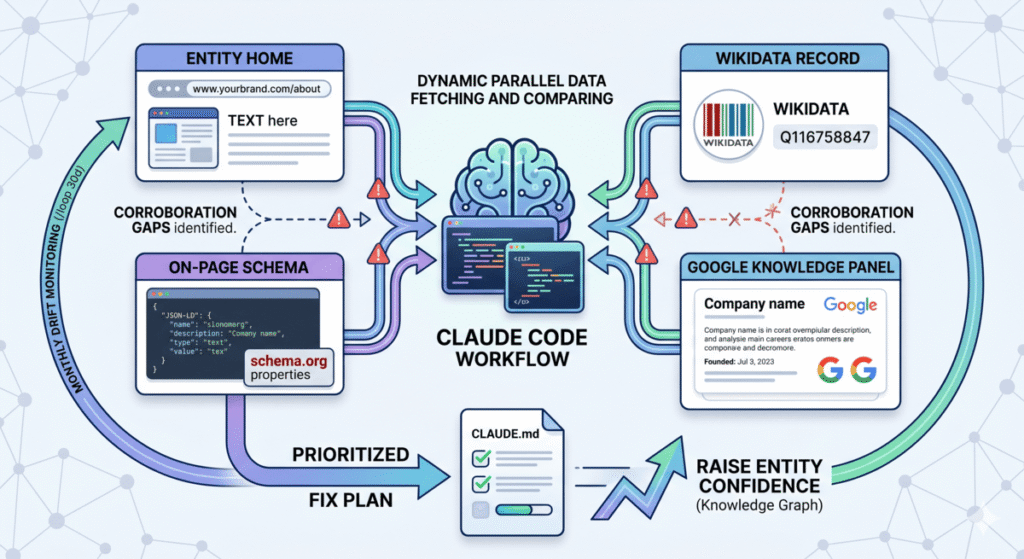
A Knowledge Panel audit compares four signals side by side, your Entity Home, your Wikidata record, your on-page schema, and the Knowledge Panel Google currently displays, then identifies which corroboration gaps are stopping Google from raising its confidence in your entity. The Claude Code workflow below runs that comparison in one session using parallel subagents, […]

How to Audit Your Google Knowledge Panel with Claude Code (2026): The 20-Minute Entity Corroboration Workflow Read More »

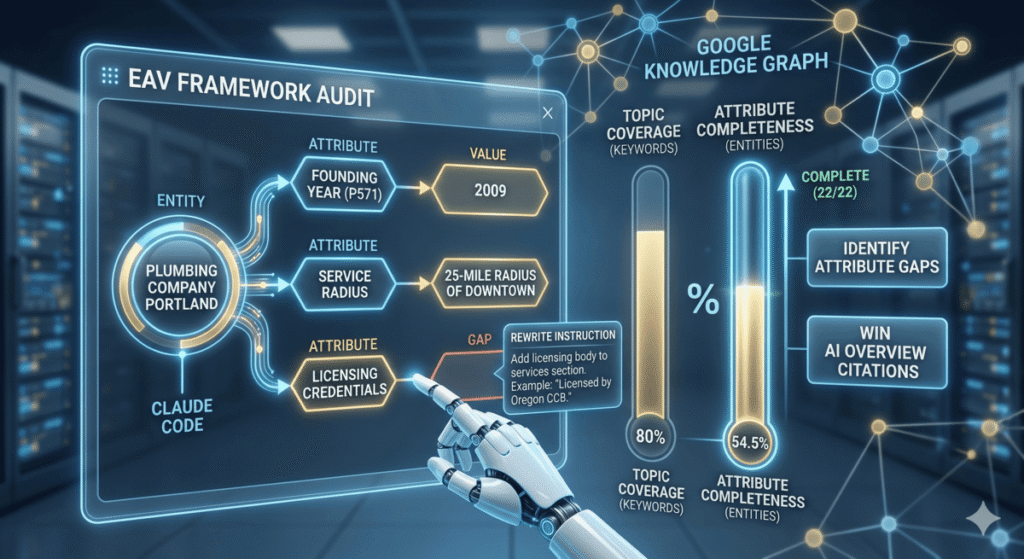
The EAV Framework: How to Structure Content So Google Reads It Like a Knowledge Graph Entry

The Entity-Attribute-Value (EAV) framework is a content structuring method that mirrors how Google’s Knowledge Graph stores information. Every entity Google recognizes, whether a brand, a person, a product, or a local service, is described through a set of attributes, each holding a specific value. A page about a plumbing company that covers services, location, and

The EAV Framework: How to Structure Content So Google Reads It Like a Knowledge Graph Entry Read More »

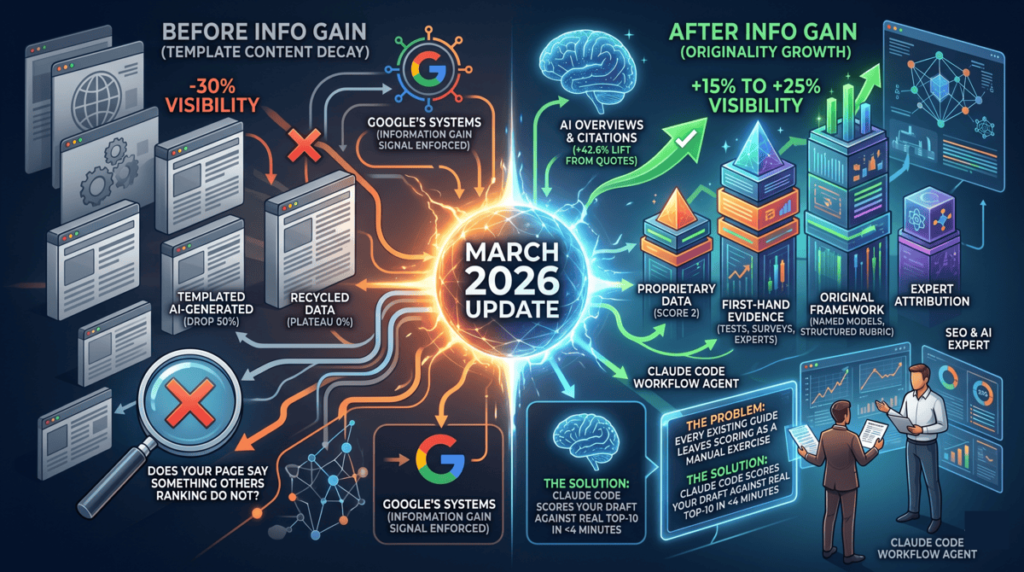
Information Gain SEO: How to Score Your Content Before You Publish Using Claude Code (2026)

Information gain is Google’s measure of how much new, original knowledge a piece of content adds to the existing web. Not freshness. Not length. Not keyword density. The question Google’s systems ask is whether your page says something that the other pages ranking for this query do not. The March 2026 core update confirmed this

Information Gain SEO: How to Score Your Content Before You Publish Using Claude Code (2026) Read More »

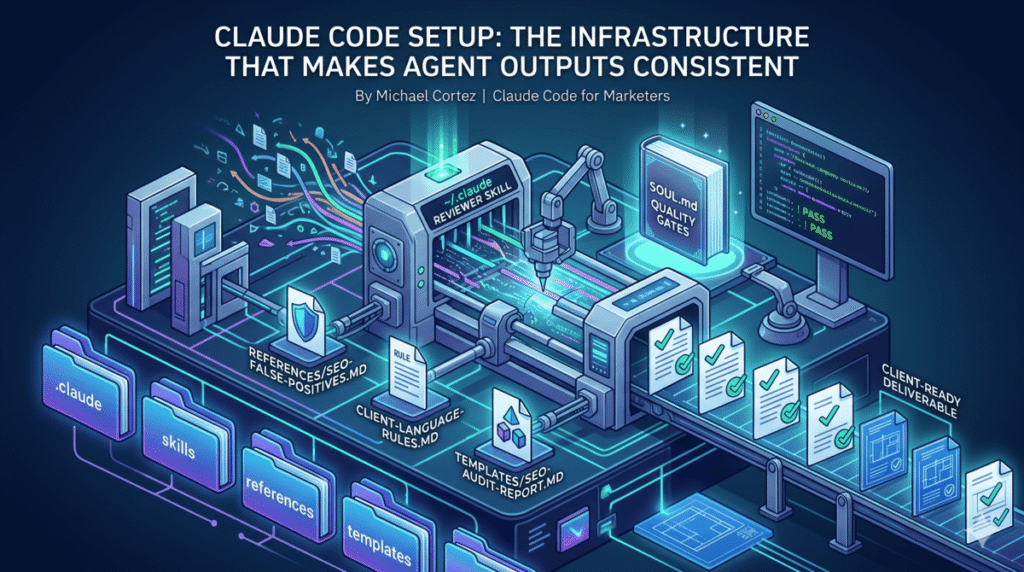
Claude Code Setup: The Infrastructure That Makes Agent Outputs Consistent

Most people set up Claude Code the same way. They create a CLAUDE.md, maybe add a few skills, and start running tasks. The folder structure looks right. The outputs vary anyway. The gap isn’t in how the folder is organized. It’s that organization and reliability are different problems, and only one of them gets covered

Claude Code Setup: The Infrastructure That Makes Agent Outputs Consistent Read More »

Entity Disambiguation and Knowledge Graph Entry: How to Teach Google Exactly Who You Are

Before Google can cite your page in AI Overviews, surface your Knowledge Panel, or give you entity-level authority on a topic, it has to be certain about something more basic: that it knows which entity you are. Not just that a “Michael Cortez” exists somewhere on the internet – but that the Michael Cortez writing

Entity Disambiguation and Knowledge Graph Entry: How to Teach Google Exactly Who You Are Read More »

Entity Signals That Drive Google AI Overview Citations (and How to Audit Yours with Claude)

Google AI Overviews do not pull citations from the top-ranked pages the way most SEOs assume. An Ahrefs study of 300,000 keywords and 4 million AI Overview URLs found that only 38% of cited pages rank in the top 10 for the same query. As recently as late 2024, that number was 76%. The shift

Entity Signals That Drive Google AI Overview Citations (and How to Audit Yours with Claude) Read More »

Google Ads AI Max in 2026: The September Deadline, What Got Smarter in April, and How to Audit Your Account with Claude

Google made three significant changes to AI Max on April 30, 2026: the feature is now out of beta, it expanded into Shopping and travel campaigns, and a new natural language control called AI Brief gives advertisers a way to guide the AI using plain language instead of keyword lists. Separately, Google confirmed that Dynamic

Google Ads AI Max in 2026: The September Deadline, What Got Smarter in April, and How to Audit Your Account with Claude Read More »

entity co-occurrence guide

How to Map Entity Co-Occurrence Gaps with Claude Code (2026)

Entity co-occurrence is one of the least talked-about ranking signals in SEO, and one of the most measurable. When Google repeatedly sees two entities appear together across thousands of web pages — “fence contractor” alongside “HOA approval,” or “mortgage broker” alongside “debt-to-income ratio” – it learns that those concepts belong together. Pages that cover a

How to Map Entity Co-Occurrence Gaps with Claude Code (2026) Read More »

How to Score Entity Salience with the Google NLP API and Claude Code (2026)

Entity salience is Google’s measure of how central an entity is to a document, expressed as a score from 0.0 to 1.0. A page about fence installation in Portland might score “fence contractor” at 0.58 and “wood staining” at 0.04. The higher the score, the more Google treats that entity as the subject of the

How to Score Entity Salience with the Google NLP API and Claude Code (2026) Read More »

Topical Authority Map SEO

Topical Authority Mapping with Claude Code: The Practitioner’s Playbook

Most “Topical Authorities” Are Keyword Lists in a Trench Coat Ask ten SEOs to define a topical map and nine of them will describe a spreadsheet: a list of keywords grouped by subtopic, maybe organized into a pillar-and-cluster structure, with a content calendar attached. They call it a topical map. What they’ve actually built is

Topical Authority Mapping with Claude Code: The Practitioner’s Playbook Read More »