To rank in ChatGPT, you need to appear in Bing’s index for the sub-queries ChatGPT generates internally, structure your content so the answer appears in the first 30% of the page with a heading that matches those sub-queries, and build third-party coverage that embeds your brand in ChatGPT’s training data. Every existing guide stops at step one. The mechanism has changed three times in three months, and most published advice is already describing behavior from a model that no longer runs.
This post covers the full citation stack as it stands in June 2026, including data from over 353,000 pages analyzed, 5 million fan-out queries, and the specific structural changes GPT-5.5 introduced that broke the playbook most people are still following.
Why Every “How to Rank in ChatGPT” Guide Published Before June 2026 Is Already Wrong
ChatGPT’s citation behavior has gone through three distinct phases since the start of 2026, each driven by a model update. The underlying algorithm does not change on a visible public schedule the way Google announces core updates. It shifts when OpenAI releases a new default model, and the citation patterns shift with it.
Here is the full arc, based on Writesonic’s citation studies covering 1,257 citations across 150 conversations:
| Model | Brand site citation rate | Site: operator in fan-out queries | Avg fan-out queries per prompt |
|---|---|---|---|
| GPT-5.2 | 22% | 0% | ~1 |
| GPT-5.3 Instant | 8-13.4% | 0% | 1.0 |
| GPT-5.4 Thinking | 56-57% | 37-40.5% | 8.5-10.5 |
| GPT-5.5 Thinking | 47% | 12.6% | 7.3 |
| GPT-5.5 Instant (free tier) | 6% | 0% | 1.0 |
The GPT-5.4 to GPT-5.5 shift is the one that broke most current strategies. GPT-5.4 used Google’s site: operator in 40.5% of its internal searches, which meant it was actively visiting brand domains directly. GPT-5.4 cited brand websites 56% of the time and commercial pages (homepages, pricing, product pages) made up 51% of all citations. Pricing page citations went from 1% under GPT-5.3 to 19% under GPT-5.4, a 35x increase.
GPT-5.5 dropped site: operator usage from 40.5% to 12.6%. Without that operator forcing a visit to brand domains, ChatGPT defaults to natural Bing search results. Natural Bing results surface Reddit threads, news coverage, comparison articles, and review platforms. Brand sites dropped from 57% to 47% in the Thinking tier, and fell from 13.4% to 6% in the Instant tier.
The overlap between GPT-5.4 and GPT-5.5 citations for the same 50 prompts was only 7%. On 22 of those 50 prompts, there was zero overlap at all. These models are effectively different search systems serving different pages for identical queries.
The Free Tier Situation Is Worse Than Most Brands Realize
The Thinking tier data is actually the optimistic scenario. Most users run ChatGPT on the free tier, which uses GPT-5.5 Instant. At 6% brand citation rate, brand-owned content is nearly absent from free-tier responses. Category-by-category on the Instant tier:
- Ecommerce, services, travel, food, fitness, comparison queries: 0% brand citations
- Healthcare: 5%
- Legal: 7%
- SaaS: 7%
- Finance and marketing: 18%
- Pricing pages across all Instant models: 0%
Reddit is now the dominant source on GPT-5.5 Instant by a factor of three. It received 38 citations in Writesonic’s test versus 11 for the second-placed domain. On GPT-5.3 Instant, Reddit received 6 citations and ranked ninth. That shift happened in a single model transition.
There is also a silent tier-switch to be aware of. Writesonic found that 8 of 50 prompts (16%) automatically escalated from Instant to the Thinking tier, even with auto-switch disabled. These re-escalated in fresh sessions, suggesting content-based routing by complexity. Broad trend queries, multi-vendor comparisons, and recommendation queries trigger it. If a free user asks “what is the best CRM for a small agency,” they may be getting Thinking-tier behavior without realizing it, and without your brand site being visible at either tier.
How ChatGPT Actually Decides What to Search For (And Why Your Keyword Doesn’t Matter)
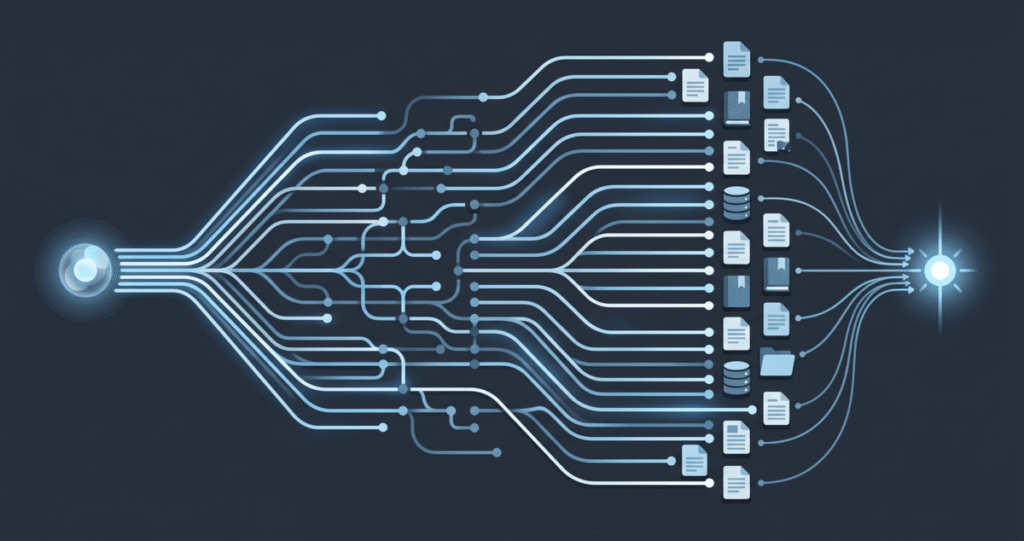
When a user types a query into ChatGPT, the model does not search for that query. It analyzes the prompt and generates a set of internal sub-queries, runs each one against Bing’s index through a tool called web.run, retrieves candidate pages, and then selects which pages to cite in its final answer. The user’s original phrasing is almost incidental to what actually gets searched.
This process is called query fan-out. It is the least understood part of ChatGPT’s citation mechanism, and it is where most citation opportunities are lost.
What the Fan-Out Data Actually Shows
AirOps analyzed 16,851 queries across 353,799 pages scraped from ChatGPT responses. Key findings:
- 88.6% of prompts generate exactly two fan-out sub-queries
- 2.5% generate four or more (complex comparative or multi-vendor queries)
- 15,000 original prompts expanded to 43,233 total queries (a 2.9x expansion)
- 32.9% of cited pages were found exclusively through fan-out sub-queries, not the original prompt
- 95% of fan-out queries have zero traditional search volume (per Ahrefs data on 110 billion keywords)
That last point matters for practitioners: nearly one-third of your ChatGPT citation surface is invisible to every conventional keyword research tool. Semrush, Ahrefs, and Google Search Console all track queries people type into search bars. Fan-out sub-queries are generated by an AI model, not typed by humans, so they do not appear in any keyword database.
Peec AI analyzed 5 million fan-out queries across ChatGPT, Perplexity, and Grok to identify what ChatGPT systematically injects into sub-queries. The top additions to user prompts:
- “best”: 15.33% of fan-outs
- “what”: 8.72%
- “review” or “reviews”: 6.84%
- “2026”: 5.44%
- “top”: 5.24%
- “comparison”: 4.48%
- “vs”: 4.27%
For recommendation queries specifically, ChatGPT injects “best” into 24.3% of fan-outs. If a user asks “what tools help with content SEO,” ChatGPT is likely running sub-queries like “best content SEO tools 2026” and “content SEO software reviews”, not the user’s exact phrasing. Pages optimized for the head term often miss every sub-query entirely.
ChatGPT also uses Reciprocal Rank Fusion (RRF) to merge results from parallel fan-out searches. Pages that appear across multiple sub-query results get higher scores. This means content that covers the topic from several angles (“best,” “comparison,” “how to”) earns compounding advantage, while pages optimized for a single head term score once and get outranked by broader pages that hit multiple sub-queries.
How to See ChatGPT’s Actual Sub-Queries for Any Prompt
You can extract the exact Bing queries ChatGPT ran for any response using browser DevTools. Here is the method:
- Enter your target prompt into ChatGPT and wait for it to trigger a live web search (you will see a “Searching…” indicator)
- Open DevTools: right-click the page and select Inspect, or press F12 on Windows or Cmd+Option+I on Mac
- Copy the conversation ID from your browser URL bar, the string after
/c/ - Go to the Network tab and paste that conversation ID into the filter field
- Refresh the page to repopulate filtered requests
- Click the second row in the filtered Name column
- Open the Response tab and search for “Queries” (Ctrl+F or Cmd+F)
- The exact Bing sub-queries ChatGPT executed will appear
You can also use the free LLMrefs fan-out extractor Chrome extension, which automates this process without requiring DevTools access.
One important limitation from NoGood’s research: 66% of fan-out queries appear only once across ten test runs. They are unstable and personalized. Chasing individual fan-out queries is not the right strategy. The correct approach is to run 20-30 related prompts, extract fan-outs for all of them, identify the recurring themes, and build content architecture that addresses those themes as a cluster rather than as individual keyword targets.
Why Ranking on Google Is Not Enough (The Bing Dependency Most Brands Ignore)
ChatGPT’s web search runs through Bing’s index, not Google’s. This is a structural consequence of the OpenAI-Microsoft partnership and it has direct implications for every brand with a Google-first SEO strategy.
Seer Interactive analyzed 500+ citations and found that 87% of ChatGPT’s cited pages match Bing’s top organic results for the same query. Google’s match rate for the same citations was 56%, at a median rank of 17 and average rank of 28.
But the data gets more complicated from there. Grow and Convert tested 100 buying-intent prompts and found that only 40% of ChatGPT’s cited sources appeared anywhere in the first 10 pages of Google or Bing results for the corresponding fan-out queries. Google accounted for 27% of matches, Bing for 23%, with some overlap.
That leaves 60% of ChatGPT’s citations coming from pages that do not rank on page 1-10 of either Google or Bing for those specific fan-out queries. The AirOps study confirmed this from a different angle: 83.4% of ChatGPT-retrieved pages were absent from Google SERPs entirely.
Those non-ranking citations are coming from two places: ChatGPT’s training data (brands, topics, and entities the model learned during training, which it references without a live search) and Bing indexing of pages that Google has not indexed or ranked. Both represent citation channels that Google-only SEO strategies miss completely.
What This Means in Practice
If your site ranks on Google but is not indexed on Bing, you have no ChatGPT citation eligibility for queries that trigger live web search. A page that does not exist in Bing’s index cannot be retrieved by web.run, regardless of its Google rankings.
Three Bing-specific actions that matter for ChatGPT visibility:
- Verify Bing indexing for your top pages. Bing Webmaster Tools has a URL inspection feature that shows indexation status and crawl diagnostics. Check it the same way you check Google Search Console for new content.
- Implement IndexNow. IndexNow lets you ping Bing directly when you publish or update content. Bing typically processes the request within 24 hours, compared to relying on a sitemap crawl cycle that may take weeks. For a site publishing twice weekly, this is the difference between content being citation-eligible this week or next month.
- Use the AI Performance report in Bing Webmaster Tools. Microsoft launched this feature in February 2026 as a public preview. It shows total AI citations for your domain, the average number of unique pages cited, and the grounding queries, which are the actual key phrases Microsoft’s AI used when retrieving your content as a source. It is the closest thing to a ChatGPT visibility report that currently exists, because ChatGPT and Microsoft Copilot pull from the same Bing index.
One technical requirement that applies across all AI systems and is frequently missed: ChatGPT, Claude, and Gemini all execute zero JavaScript. They cannot read lazy-loaded content, cannot process dynamically injected text, and require server-rendered static HTML. A page that depends on JavaScript to render its main content is invisible to AI crawlers regardless of its Bing or Google rankings. This finding comes directly from Writesonic’s technical analysis of ChatGPT’s crawl behavior.
What the Data Actually Says About Citation Probability
The AirOps fan-out study is the most rigorous analysis of ChatGPT citation determinants published to date. It scraped 353,799 pages, scored each on 15 variables, and measured actual citation rates against each variable independently. The results challenge several widely held assumptions.
Retrieval Rank Is the Dominant Variable
Citation rate by Bing retrieval position:
| Bing position | Citation rate |
|---|---|
| 1 | 58.4% |
| 2 | 54.4% |
| 3 | 35.5% |
| 6 | 24.6% |
| 10 | 14.2% |
Position 1 on Bing produces a citation rate four times higher than position 10. Pages cited across all three test runs had a median retrieval rank of 2.5. Pages never cited had a mean rank of 13. Even pages with strong heading-to-query match (similarity score above 0.8) drop from a 79.6% citation rate at rank 1 to 21.5% at rank 11 or higher.
The implication is direct: content quality cannot overcome poor Bing ranking. You need retrieval visibility first. Everything else is marginal improvement on top of that foundation.
Heading Match to the Query Is the Primary On-Page Lever
AirOps measured citation rate by how closely a page’s headings matched the sub-query that retrieved it:
| Heading similarity score | Citation rate |
|---|---|
| Below 0.50 | 30.2% |
| 0.70-0.79 | 31.0% |
| 0.80-0.89 | 34.5% |
| 0.90 or above | 41.0% |
At top retrieval ranks (positions 0-2), high heading similarity adds 19 percentage points: 55.9% citation rate at low similarity versus 75.3% at high similarity. Heading structure outperforms word count, topical breadth, domain authority, and body copy density as a citation predictor.
The practical application: your H1 should contain the head query, and your H2s should mirror the exact phrasing of the fan-out sub-queries ChatGPT generates for that topic. If ChatGPT searches “best content SEO tools 2026” as a fan-out, a page with “Best Content SEO Tools in 2026” as an H2 will outperform a page whose H2 says “Top Picks for Content Optimization.”
Word Count: Shorter Wins (Not What Most SEO Guides Tell You)
Citation rate by word count:
| Word count | Citation rate |
|---|---|
| Below 500 | 30.5% |
| 500-999 | 34.3% |
| 1,000-1,499 | 32.9% |
| 5,000+ | 28.6% |
Pages above 5,000 words underperform pages under 500 words. The sweet spot is 500-999 words for maximum citation rate. Comprehensive ultimate guides score worse than focused topic pages.
This connects to a finding about subtopic coverage: pages covering 26-50% of relevant subtopics outperform pages covering 100% of them (38.2% vs. 34.0% citation rate when query relevance is held constant). ChatGPT is not rewarding encyclopedic coverage. It is rewarding pages that answer one question very well.
Content Position: Front-Load Your Answer
Kevin Indig’s analysis of 1.2 million ChatGPT responses (18,012 verified citations, p-value 0.0) found a “ski ramp” distribution:
- First 30% of page content: 44.2% of all citations
- Middle section (30-70%): 31.1% of citations
- Final third: 24.7% of citations
Within paragraphs, the middle sentences receive 53% of citations versus 24.5% for first sentences and 22.5% for last sentences. The practical implication: long introductions, contextual preambles, and “in this post I will cover…” openings push your actual answer past the first 30% threshold where citation rates drop. Put the answer at the top.
Five Content Traits That Predict Citation
From Indig’s study, these five traits each approximately doubled citation likelihood:
- Definitive language. Sentences that use “X is” or “X refers to” structures were nearly twice as likely to receive citations as vague framing. ChatGPT cites definitions.
- Question-and-answer structure. Content containing question-format headings showed 2x citation likelihood overall, with 78.4% of cited content in this format having the citation pulled from the heading itself.
- Entity richness. Cited text averaged 20.6% proper nouns versus 5-8% in standard text, nearly 3x higher entity density. Named people, tools, companies, frameworks, and specific data points increase citation probability.
- Balanced sentiment. The optimal subjectivity score was 0.47 on a 0-to-1 scale. Content that mixes factual reporting with measured interpretation outperforms purely neutral or heavily opinionated content.
- College-level readability. Flesch-Kincaid grade 16 outperforms grade 19.1. Accessible prose that does not require a graduate degree to parse performs better than dense academic writing.
The AirOps study also confirmed a specific format boost: answer capsules of 40-60 words placed at the start of each section showed a 72.4% citation rate. Critically, 91% of cited capsules contained zero links. ChatGPT does not prefer highly linked content for extraction. It prefers clean, self-contained statements.
Domain Authority Shows an Inverse Correlation
This is the finding that most contradicts traditional SEO intuition. In the AirOps dataset:
- Always-cited pages: average DA 53, average backlinks 1.1 million
- Never-cited pages: average DA 56.7, average backlinks 3.2 million
At every query-match level, the lowest domain authority quartile performed equal to or better than the highest. Domain authority and backlink count do not predict ChatGPT citation rates. Page-level relevance and structure do.
Wikipedia is the one exception that proves the rule. It achieves a 59.2% citation rate despite a median retrieval rank of 24 and only 3.6% of pages in the top 3. Its differentiator is pure content density: 4,383 average words, 31 lists per page, 6.6 tables per page. No other site type replicates this pattern at scale, and it is not a realistic model for most publishers.
Why Third-Party Coverage Matters More Than Your Own Content Now
GPT-5.5’s collapse of the site: operator changed the fundamental equation. When GPT-5.4 used that operator, it was actively seeking out brand-owned content. Without it, ChatGPT defaults to whatever natural search surfaces, which is the ecosystem of sources talking about your brand rather than sources owned by your brand.
The data on this is consistent across multiple research sources. AuthorityTech found that brands are 6.5x more likely to be cited by AI engines through third-party sources than through their own domains. “Best X” listicles alone account for 43.8% of ChatGPT-cited pages.
Where Citations Are Actually Coming From
According to the 5W Citation Source Audit (Q1 2026), a synthesis of nine independent datasets covering over 600,000 citations:
- Wikipedia: 13.15% of all US ChatGPT citations
- Reddit: 11.97% of all US ChatGPT citations
- LinkedIn: cited in 14.3% of ChatGPT Search responses (SEMrush data)
- Reuters: 2.27%
- Forbes: 1.38%
- WSJ, NYT, Bloomberg, Financial Times: not in the top 20
YouTube overtook Reddit as the most-cited social platform in LLM answers overall as of January 26, 2026, confirmed by four independent research firms. YouTube appears in 16% of LLM answers versus Reddit’s 10%. YouTube’s share of social citations went from 18.9% in August 2025 to 39.2% in December 2025. The mechanism is transcripts: YouTube video content was previously hard for AI systems to parse, but transcripts, descriptions, and chapter titles turn videos into dense text blocks that score well on entity richness and question-answer structure.
How AI Engines Assign Different Jobs to Different Sources
SEJ research found that AI engines do not simply select the most authoritative sources. They assign sources to specific functions within an answer:
- Reddit handles consumer reassurance, personal experience, and “why” questions. It is cited about twice as often in ChatGPT as in Google AI Overviews for instructional content. In ChatGPT, Reddit appears with medical authorities (Mayo Clinic, Healthline) 36% of the time, which BrightEdge describes as a “6x authority flip” from how Reddit is treated in traditional search.
- LinkedIn handles professional capability questions, B2B context, and career queries. LinkedIn is now the number one cited domain for professional queries across all six major AI platforms, rising from approximately rank 11 to rank 5 within three months.
- Wikipedia handles definitional queries, entity disambiguation, and high-density factual coverage.
- YouTube handles demonstration queries, product reviews, and expertise with visual evidence.
- Government sites handle trust-signal queries. At high relevance, government pages cite at 49.1% versus 35.2% for non-government sources, a 13.9 percentage point gap.
Brands on G2, Capterra, Trustpilot, and Yelp see approximately a 3x citation multiplier versus those without review platform profiles. This is because review platforms function as the validation layer in ChatGPT’s answer assembly. When ChatGPT needs to corroborate a brand claim, it turns to review platforms as the trust signal source.
The Citation Decline Context (What This All Means Strategically)
SEOClarity’s analysis across the US, UK, Canada, Germany, and Italy (February to April 2026) found that total citation volume dropped 86-94% across all markets. The US zero-citation rate doubled from 28% to 48% in a single month. Germany reached an 85% zero-citation rate by April.
This does not mean ChatGPT is less useful for brand visibility. It means that for queries ChatGPT already “knows” the answer to from training data, it increasingly does not search the web at all. ChatGPT increasingly answers from training data rather than live retrieval. For queries it already knows well, it often does not search the web at all, and only brands embedded in the training corpus get recommended.
The strategic frame that fits this data: training data presence and third-party coverage are the floor. Bing ranking and content structure are the ceiling. Both matter for different query types, and a strategy that ignores either channel will miss a large portion of citation opportunities.
The Claude Code Workflow: Auditing and Closing Your ChatGPT Citation Gaps
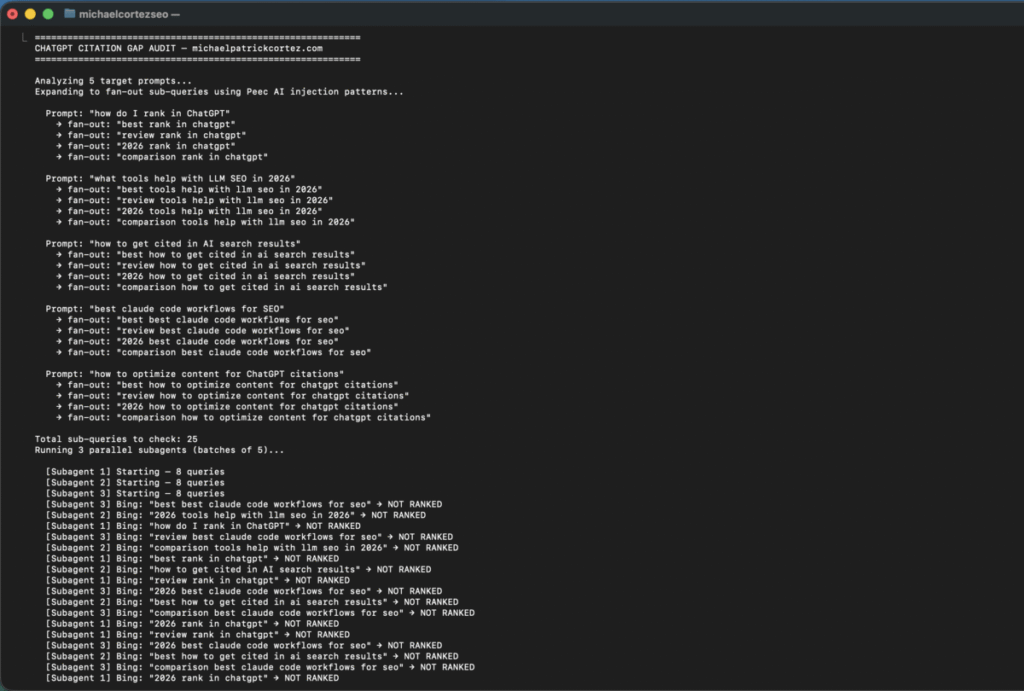
The following workflows are built for Claude Code with MCPs connected. Each one surfaces a specific gap in ChatGPT citation coverage and generates an action plan to close it.
Workflow 1: Extract and Map Your Fan-Out Sub-Query Coverage
This workflow identifies the fan-out sub-queries ChatGPT generates for your target prompts, then checks whether your content ranks on Bing for those sub-queries. Most brands discover they rank well on Google for head terms but have zero Bing presence for the sub-queries that actually drive ChatGPT citations.
Start by saving your target prompts to CLAUDE.md. A prompt is not a keyword, it is the full question a prospective customer would ask ChatGPT in a research context. For an SEO agency, that might be “what SEO tools should I use in 2026” or “how do I improve my Google rankings without an agency.”
Then run this in Claude Code:
Read CLAUDE.md to get the target prompt list.

For each prompt:
1. Run a WebFetch MCP call to extract fan-out sub-queries using the DevTools method
2. For each sub-query, call the DataForSEO Bing SERP API via Bash to pull positions 1-20
3. Cross-reference against my GSC organic keyword data to identify sub-queries where I rank on Google but not on Bing

Write a gap report to ~/fanout-gaps.md with:
- Sub-queries where Bing rank is absent or below position 10
- The closest existing page on my site that could rank for each gap
- Whether that page is server-rendered or JavaScript-dependent (flag JS pages as citation-ineligible)

Run three parallel subagents, one per five prompts, to complete the full extraction in under 3 minutes instead of 15.
The parallel subagent structure is what makes this viable at scale. Extracting fan-out sub-queries manually for 15 prompts would take 20-30 minutes. Three subagents running simultaneously reduce that to under 3 minutes, with results written directly to a file rather than pasted into a document.
Once you have the gap report, the action is targeted: submit the gap pages to Bing via IndexNow, update their H2s to mirror the exact sub-query phrasing, and ensure they are server-rendered.
Workflow 2: Generate Answer Capsules for Every Section
An answer capsule is a 40-60 word, self-contained statement that directly answers the question posed by a section heading. The AirOps data shows a 72.4% citation rate for pages that include them. Most published content does not have them, because writers naturally provide context and build to an answer rather than leading with it.
Read the draft at ~/blog-posts/drafts/[post-name].html

For each H2 and H3 in the document:
1. Extract the heading text
2. Check whether the first 60 words after that heading contain a direct, self-contained answer to the question posed by the heading
3. If not, generate a 40-60 word answer capsule in definitive language ("X is..." or "To do X, you...") and insert it as the first paragraph of that section
4. Flag any heading that is not phrased as a question and suggest a question-format alternative
5. Write the updated draft back to the same file path

Run the clean check after writing: python3 -c "content=open('~/blog-posts/drafts/[post-name].html').read(); issues=[i+1 for i,l in enumerate(content.split('\\n')) if chr(8212) in l]; print(issues or 'CLEAN')"
This is not a prompt you paste into ChatGPT because it requires direct file system read/write access (only available in Claude Code via the Edit and Write tools), the structured HTML parsing, and the automated em dash check as part of the same workflow. The result is a file ready to publish rather than a response you need to manually transfer.
Workflow 3: Audit Your Third-Party Citation Presence
The 6.5x third-party citation multiplier means knowing where your brand appears (and does not appear) in the sources ChatGPT prioritizes is a more actionable signal than tracking your own domain’s citation rate.
Read CLAUDE.md for brand name and category.

Run five parallel WebFetch calls:
1. Top 3 Reddit threads in r/SEO and r/marketing mentioning "[brand category] tools 2026"
2. G2 and Capterra profile pages for the brand (check if profiles exist, and whether reviews mention the brand by name)
3. Top 5 "best [category] tools" listicles currently ranking on Bing
4. LinkedIn search for "[brand name]" to identify whether any posts discuss the brand
5. Wikipedia entry for the primary category to check whether the brand or site is mentioned

Write a citation presence audit to ~/citation-audit.md:
- Present: sources where brand appears (with exact URL and anchor text)
- Absent: high-priority sources where brand is missing
- Competitor presence: list which competitors appear in each source where brand is absent
- Priority actions: ranked by citation volume of the source
The output gives you a concrete action list: claim or improve your G2/Capterra profile, participate in specific Reddit threads where competitors are mentioned but you are not, reach out to the three listicles where you are absent. None of that requires a paid link or a PR agency.
Workflow 4: Weekly Brand Citation Monitoring with /loop
The SISTRIX data showed citation patterns shifting 47% within 48 hours of a model update. Manual weekly checks cannot keep up with that velocity. This workflow samples your citation rate automatically and logs it to CLAUDE.md so you see trend lines rather than point-in-time snapshots.
Save this as ~/.claude/skills/chatgpt-citation-monitor/SKILL.md

Then run: /loop 7d /chatgpt-citation-monitor

On each run, the skill:
1. Calls the DataForSEO ai_mode endpoint with 10 representative prompts in your category
2. Checks whether your domain appears in any citations for each prompt
3. Logs citation count and percentage to CLAUDE.md under ## Citation Monitor Log
4. Compares against the previous week's log
5. If citation rate drops more than 20% week-over-week, writes a flag to CLAUDE.md: "ALERT: Citation drop detected. Review model update news."
The /loop 7d command schedules this to repeat every seven days without manual intervention. The skill reads and writes to CLAUDE.md so context accumulates over time. After four weeks you have a trend line rather than a single data point, which is the only way to distinguish a model-update-driven drop from normal variability.
This is the kind of monitoring a tool like Profound or Ahrefs Brand Radar provides at a paid tier. The Claude Code implementation gives you the same signal using the DataForSEO API at a fraction of the cost, with the additional benefit that the data stays in your own CLAUDE.md rather than in a third-party platform.
What Changes by Query Type (Not All ChatGPT Queries Work the Same Way)
The citation strategies above apply broadly, but citation rates vary significantly by query intent. From the AirOps data:
- Product discovery: 18.3% citation rate (highest)
- How-to: 16.9%
- Comparison: 13.1%
- Validation: 11.3% (lowest)
Product discovery and how-to queries have the highest citation rates because they reliably trigger web search. ChatGPT knows it needs current data for “best X in 2026” queries. Validation queries (“is X safe” or “does X work”) are more likely to be answered from training data, reducing the live search citation rate.
This also varies by freshness requirements. Research published in 2026 found that content updated within 30 days earns approximately 3.2x more ChatGPT citations than content older than 12 months. But the AirOps study adds important nuance: content in the 30-89 day range actually outperforms very fresh content (32.8% vs 25.3% citation rate for under-30-day content). The likely reason is that extremely new content has incomplete Bing indexing. The practical cadence is a 90-day review cycle: substantive update with at least one new data point or section refreshed, then IndexNow ping.
Vertical variation matters here too. Finance and travel content decays fastest, with freshness gaps of 15-19 percentage points between 30-day content and 5-year-old content. Health content is the opposite: 1-2 year content actually outperforms fresh content, likely because established medical guidance is more trusted than newly published claims.
The Full Checklist: What to Audit First
Given everything above, here is a priority-ordered audit sequence. Start with the items that have the largest impact on retrieval visibility before optimizing on-page elements:
- Bing indexation check. Verify your top 20 pages are indexed on Bing, not just Google. Use Bing Webmaster Tools URL inspection or
site:search on Bing. Fix any indexation gaps with IndexNow. - JavaScript rendering audit. Identify any pages where main content is loaded via JavaScript. Those pages are invisible to ChatGPT regardless of their Bing rankings. Server-render the content.
- Fan-out query extraction. Run the DevTools extraction method for your 10 most important prompts. Identify the sub-queries, check whether your content ranks on Bing for them, and update H2s to match sub-query phrasing.
- Answer capsule audit. Check whether the first 60 words after each H2 deliver a direct, definitive answer. If not, restructure to front-load the answer before providing context and evidence.
- Third-party presence audit. Check G2/Capterra profiles, top Reddit threads in your category, and the three highest-traffic “best [category]” listicles on Bing. Identify gaps.
- Content freshness check. Any substantive page older than 90 days without an update is losing citation share to fresher competitors. Add a 90-day review cycle with IndexNow pings on update.
- Training data signals. For queries that do not trigger live search, the only path to citation is being embedded in ChatGPT’s training corpus. Signals that correlate with training data presence: Wikipedia mentions, industry publication coverage, recognized expert references, and Reddit threads that discuss your brand by name. These take months to build but are the most durable citation channel.
Frequently Asked Questions
Does ChatGPT use Bing or Google for search results?
ChatGPT uses Bing’s index for live web search through an internal tool called web.run. This is a structural result of the OpenAI-Microsoft partnership. Seer Interactive found that 87% of ChatGPT citations match Bing’s top organic results for the same query, versus 56% for Google at a median Google rank of 17-28. Pages that are not indexed on Bing cannot appear in ChatGPT’s live search citations regardless of their Google rankings.
How much did GPT-5.5 change what gets cited compared to GPT-5.4?
Significantly. GPT-5.4 cited brand websites 56-57% of the time using a site: operator in 40.5% of its internal queries, which forced it to visit brand domains directly. GPT-5.5 dropped site: operator usage to 12.6%, lowering brand site citation rates to 47% in the Thinking tier and 6% in the Instant (free) tier. Citation overlap between the two models for identical prompts was only 7%. The mechanism driving the change is well-documented in Writesonic’s April 2026 study covering 1,257 citations across 150 conversations.
Does domain authority affect ChatGPT citation rates?
No, and the data shows an inverse relationship. In AirOps’ analysis of 353,799 pages, never-cited pages averaged a higher domain authority (56.7) and more backlinks (3.2 million average) than always-cited pages (53 DA, 1.1 million backlinks). ChatGPT evaluates page-level relevance and content structure, not domain-level authority signals. A focused 800-word page with a heading that matches the query will outperform a 4,000-word comprehensive guide on a high-DA domain if the shorter page ranks higher on Bing for the relevant sub-query.
What type of content does ChatGPT cite most often?
Based on the AirOps fan-out study, ChatGPT cites content with these structural traits most often: headings that match the query at a cosine similarity of 0.9 or higher, answer capsules of 40-60 words placed immediately after each section heading, sequential H1-H2-H3 hierarchy (present in 68.7% of cited pages versus under 25% of Google page-one results), and JSON-LD schema markup (adds 6.5 percentage points independent of other factors). Product discovery content has the highest overall citation rate (18.3%) followed by how-to content (16.9%).
How do I know if ChatGPT is currently citing my website?
Three methods: (1) Bing Webmaster Tools’ AI Performance report, launched in February 2026, shows how often your content is cited as a source in AI-generated answers and the grounding queries used to retrieve it. (2) DataForSEO’s ai_mode API endpoint lets you test specific prompts programmatically and check citation presence. (3) Manual sampling: run 10-15 relevant prompts in ChatGPT (Plus/Pro tier to ensure web search is active), search for your domain in the citation list for each response. The Claude Code monitoring workflow above automates option 2 on a weekly schedule.
Why does ChatGPT cite Reddit and Wikipedia so much?
Different structural reasons for each. Reddit scores well because its thread format matches the “Problem-Solution-Validation” answer structure ChatGPT prefers, and upvoted community responses carry consensus signals the model interprets as credibility. Wikipedia scores well due to extreme content density (4,383 average words, 31 lists per page, 6.6 tables per page), which overcomes its poor Bing retrieval rank (median rank 24). Wikipedia achieves a 59.2% citation rate despite appearing in only 3.6% of top-3 results. For most publishers, Wikipedia’s citation advantage is not a model to replicate because it depends on density at a scale that takes thousands of volunteer editors to maintain.
What is query fan-out and why does it matter for ChatGPT rankings?
Query fan-out is ChatGPT’s process of expanding a single user prompt into multiple internal sub-queries before assembling its answer. AirOps found that 88.6% of prompts generate at least two sub-queries, and 15,000 prompts expanded to 43,233 total queries. 32.9% of cited pages are found only through fan-out sub-queries, not the original prompt. 95% of fan-out queries have zero traditional search volume, so keyword research tools cannot track them. Optimizing for fan-out means identifying the recurring sub-query themes for your topic through extraction or testing, then building content and heading structure around those themes rather than head keywords.
What to Do This Week
The most common mistake in ChatGPT optimization right now is treating it as a Google SEO variant with slightly different signals. The data is clear that these are different systems. High DA does not predict citation. Google rank barely predicts citation. Bing rank, heading-to-query match, third-party coverage, and training data presence are the actual levers.
If you are starting from scratch, the most productive first action is the fan-out extraction audit. Fifteen minutes with DevTools on your top five prompts will show you exactly what ChatGPT is actually searching for when your target customers ask about your category. Most brands discover they are not ranking on Bing for any of those sub-queries, which explains citation gaps that content improvements alone cannot fix.
For the broader picture of how LLM visibility fits into your overall search strategy, the LLM SEO guide covers the full architecture across ChatGPT, Perplexity, Google AI Overviews, and Claude. And if you want to understand how to measure and improve your presence across all AI answer engines, not just ChatGPT, the answer engine optimization guide walks through the platform-by-platform differences that matter.
One thing worth understanding before you optimize exclusively for ChatGPT: Perplexity uses a completely different citation logic, and strategies that lift your ChatGPT presence often pull against your Perplexity visibility. The data behind that conflict and how to build separate playbooks for each is covered in detail in why one AI citation strategy cannot win both platforms at the same time.