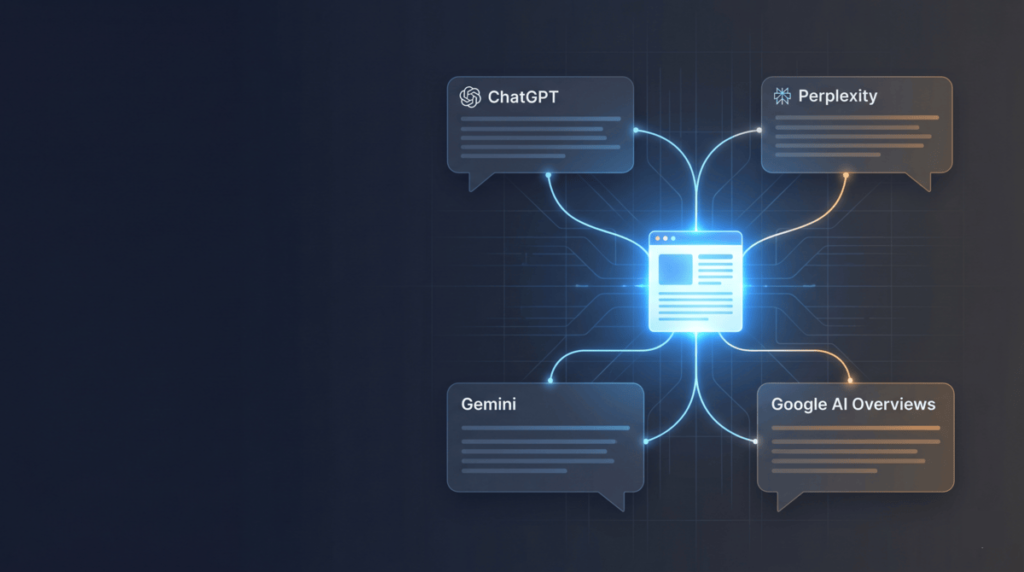
LLM SEO is the practice of getting your brand cited and recommended inside AI-generated answers from ChatGPT, Perplexity, Google AI Overviews, Gemini, and Claude. It is not a replacement for traditional SEO. It sits on top of it. The two biggest levers are the same ones that have always mattered, applied to a new surface: rank well in classic search (most engines pull from Google or Bing), and build authoritative third-party mentions of your brand. The rest is structure and measurement. This guide gives you the per-engine mechanics, the evidence behind each tactic, an honest read on what is overhyped, and a Claude Code workflow to measure your AI visibility instead of guessing at it.
What is LLM SEO?
LLM SEO means optimizing your content and your off-site presence so that large language models can find you, understand you, and cite you when they answer a user’s question. When someone asks ChatGPT “what is the best project management tool for agencies,” the brands that show up in that answer did not get there by accident. They got there because the model’s retrieval system surfaced sources that mention them, and those sources were authoritative enough to trust.
The term gets used interchangeably with a few others, and the overlap causes real confusion. Here is how they actually relate.
| Term | What it focuses on |
|---|---|
| LLM SEO / LLMO | Getting your brand cited and recommended across the language models themselves (ChatGPT, Claude, Gemini, Perplexity). |
| GEO (Generative Engine Optimization) | Structuring your content so generative engines can extract and reuse it. The on-page side. |
| AEO (Answer Engine Optimization) | Optimizing to win direct answers, featured snippets, and answer boxes. Predates LLMs. |
In practice these are layers of the same job, not competing disciplines. You structure content for extraction (GEO), format it to answer questions directly (AEO), and build the brand authority that gets you cited (LLM SEO). I treat them as one workflow, and this post does too. If you want the deeper treatment of the answer-box side, I covered it in my answer engine optimization playbook.
How do LLMs find and use your content?
There are two pathways, and they call for different tactics.
The training pathway. Models are trained on large web crawls (Common Crawl is the best-known source). Content that existed when the model was trained becomes part of its parametric memory, the knowledge baked into the weights. This is slow-moving and you cannot influence it directly for a model already trained. What you can do is build a consistent, widely-referenced presence so that by the time the next model trains, your brand is part of the corpus it learns from.
The retrieval pathway. This is where most of the action is. When you ask ChatGPT or Perplexity a question that needs current information, the system runs a live search, pulls a handful of pages, and generates an answer grounded in them. This is retrieval-augmented generation, usually shortened to RAG. The plain-language version: the model does a quick search, reads the top results, and writes an answer based on what it found, with citations.
The retrieval pathway is the one you optimize for week to week, because it responds to changes in your content and your rankings. The training pathway is the long game you play with brand building.
Does LLM SEO replace traditional SEO?
No, and the data is blunt about it. Multiple 2026 analyses, including Ahrefs’ work on how to rank in ChatGPT, point to the same relationship: pages that rank on the first page of Google get cited by AI engines the large majority of the time, and top-three positions more often still. The figures circulating across these studies sit around 77 percent citation for page-one results and roughly 82 percent for top-three. Treat the exact percentages as directional, since they come from sampled studies rather than a census, but the direction is not in dispute. Classic rankings predict AI citations.
This is the single most important thing to internalize. If you abandon traditional SEO to chase “LLM SEO” as a separate thing, you remove the foundation the citations are built on. ChatGPT’s web search runs on Bing. Google AI Overviews and Gemini pull from Google’s index. Win the underlying search first. Then optimize for the extra signals that move AI citation specifically.
How do you get cited by each AI engine?
Most guides treat “ChatGPT, Perplexity, Claude, and AI Overviews” as one undifferentiated blob and give you a single checklist. That is the biggest gap in the existing content, because the engines retrieve from different places and reward different things. Here is the breakdown, drawn from published citation research and each platform’s documented behavior.
| Engine | Retrieves from | Favored sources | The move that matters most |
|---|---|---|---|
| ChatGPT Search | Bing index plus live web | Authoritative pages, Wikipedia, third-party “best of” lists | Rank in Bing and earn third-party listicle mentions |
| Perplexity | Its own crawler plus real-time web | Fresh pages, Reddit, community discussion | Recency and genuine community presence |
| Google AI Overviews | Google’s index | Top-ten organic results, deep pages | Win classic Google rankings first |
| Gemini | Google index plus Google ecosystem | Structured, extractable answers, YouTube | Answer-first formatting and schema |
| Claude | Claude web search plus training data | Established, authoritative sources | Brand mentions and topical authority over time |
Two source-bias findings are worth calling out because they change tactics. Profound’s analysis of roughly 30 million AI citations found that Wikipedia accounts for nearly half of ChatGPT’s top citations, while Reddit makes up close to half of Perplexity’s, and Google AI Overviews leans on Reddit (around a fifth of citations) and YouTube. If you are trying to influence Perplexity, an authentic answer in the right subreddit can do more than another blog post. If you are trying to influence ChatGPT, getting onto the third-party reference and comparison sources it trusts matters more than your own site. Same goal, different doors.
Which AI crawlers do you need to allow?
You cannot get cited if the engines cannot crawl you. Check your robots.txt for these user agents and make sure you are not blocking the ones you want:
- GPTBot and OAI-SearchBot and ChatGPT-User (OpenAI)
- PerplexityBot (Perplexity)
- ClaudeBot (Anthropic)
- Google-Extended (controls Gemini and AI training use of your content)
- Applebot-Extended (Apple Intelligence)
There is a real decision here, not just a checkbox. Allowing these bots lets the engines use and cite you. Blocking Google-Extended, for example, keeps your content out of Gemini training. Most brands that want AI visibility should allow all of them. The exception is if you have a specific reason to protect proprietary content from training, in which case you allow the search-and-cite bots and block the training bots where the engine separates them.
Do AI crawlers render JavaScript?
Mostly no, and this trips up sites built on heavy client-side frameworks. Vercel’s crawler analysis measured this across its network and found that AI crawlers fetch JavaScript files but do not execute them. In their published data, GPTBot generated hundreds of millions of requests in a month and Claude’s crawler hundreds of millions more, together amounting to a meaningful fraction of Googlebot’s volume, yet neither rendered the JavaScript the way a browser does. The practical takeaway: if your important content only appears after client-side JavaScript runs, AI crawlers may never see it. Serve content as server-rendered or static HTML so the text is in the initial response.
How should you structure content to get cited?
LLMs extract passages, not whole pages. The structural moves that help are the ones that make a clean, self-contained answer easy to lift.
- Front-load the answer. Put a direct, complete answer in the first 40 to 60 words under each question heading. The model often pulls from the opening of a relevant section.
- Write question-format headings. Headings that match how people actually ask (“How do you get cited by ChatGPT?”) line up with the queries the engines are resolving.
- Keep paragraphs short. Two to four sentences. Reporting from multiple 2026 citation studies suggests answer-first formatting and short paragraphs correlate with materially higher citation rates.
- Use schema markup. Article, FAQPage, HowTo, Organization, and Person schema give the engines a machine-readable map of what your page is about and who stands behind it.
Schema deserves its own note. Structured data does not magically force a citation, but it reduces ambiguity about your entities and relationships, and reduced ambiguity is exactly what a retrieval system rewards. For brand and author credibility specifically, Organization and Person schema tie your content to a recognized entity, which connects to the brand-authority signal covered next.
Do brand mentions matter more than backlinks?
For AI citation, brand mentions carry weight that classic SEO underrates. The recurring finding across 2026 citation research is that a large majority of the citations for broad, category-level questions point to third-party sources, not the brand’s own website. Across that same body of research, brand authority repeatedly shows up as one of the strongest predictors of whether a brand gets cited at all.
This is where entity strategy and AI visibility meet. Getting recognized as a distinct, well-understood entity is the foundation, which is the work Jason Barnard has documented for years through Brand SERP and Knowledge Panel research. An engine that clearly understands who you are, what you do, and what you are associated with has an easier time deciding to cite you. The tactical layer on top of that recognition:
- Get onto the third-party “best of” and “top tools” listicles in your category. These are among the most-cited formats for commercial questions.
- Build a genuine presence where the engines look. Reddit for Perplexity. Established reference sources for ChatGPT. YouTube for Gemini.
- Earn coverage and mentions from sites the models already trust, the same way digital PR earns links, except the mention itself carries value even without a link.
If you have not built the entity foundation yet, start with my guide on how to get mentioned in Claude and other AI, then layer the topical depth on top.
How does topical authority fit in?
Single pages rarely win AI citations on their own for competitive topics. Coverage does. Koray Tugberk Gubur built much of the modern thinking on topical authority, the idea that comprehensive, well-connected coverage of a subject area signals expertise an engine can trust. For LLM SEO this matters twice over: a deep topical cluster gives the retrieval system more relevant passages to pull from, and the internal structure of a well-built cluster helps the engine understand how your content fits together. This is the same hub-and-spoke approach I use for everything in my Claude for SEO workflow. A pillar like this page, supported by focused posts on each sub-topic, beats thirty scattered articles every time.
How do you measure your LLM visibility with Claude Code?
Here is the part almost every guide skips. They tell you to “track your share of voice” and then say nothing about how. Measurement is the difference between doing LLM SEO and guessing at it. This is the workflow I run, and it is genuinely agent-native, meaning it does things you cannot replicate by pasting a prompt into a chat window.
The idea is simple. You define a set of prompts a real buyer would ask in your category, run them across the major engines on a schedule, record which brands and sources get cited, and watch how your share changes over time. Doing that by hand once is tedious. Doing it every week by hand is impossible. So you build it as a Claude Code routine.
The setup
First, the project remembers its own context. In the project’s CLAUDE.md file, store the brand name, the competitor set, and the list of category prompts you want to track. The skill reads this on every run, so you never re-enter it:
## AI Visibility Tracking
Brand: Acme Analytics
Competitors: Tableau, Looker, Mode
Prompts:
- best analytics tools for agencies
- Tableau alternatives for small teams
- how to build a marketing dashboard
Engines: ChatGPT, Perplexity, Gemini, Claude
The run
The skill launches parallel subagents, one per prompt, each querying the engines and parsing the response for brand and source citations. Running them in parallel rather than one after another is what makes it usable: thirty prompts across four engines, run sequentially, is a long, babysat afternoon. Run as parallel subagents, the batch finishes while you get coffee. Each subagent returns a small structured record (which brands were named, which URLs were cited, what position your brand held in the answer).
For the data you can pull through connected tools, the workflow uses named MCP calls instead of manual exports. mcp__claude_ai_ahrefs__keywords-explorer-overview confirms the search demand behind each prompt so you are tracking questions people actually ask. If you have Search Console connected, mcp__claude_ai_ahrefs__gsc-keywords shows which AI-adjacent queries already drive impressions to your site, which is how you find the questions you are close on but not yet winning.
The output and the schedule
The skill writes results straight to a file. No copy-paste. It appends each run’s share-of-voice numbers to a tracking sheet (through the Google Drive MCP, or to a local CSV) and writes a short summary back into CLAUDE.md under a results header, so next week’s run has last week’s baseline to compare against.
Then you make it recurring. Save the whole thing as a skill file at .claude/skills/ai-visibility/SKILL.md and schedule it:
/loop 7d /ai-visibilityThat one line turns a manual audit into a standing measurement system. Every seven days it re-runs the prompt set, updates the sheet, and flags movement, without you touching it. If you have built skills before, this fits the same pattern I described in building custom Claude skills for SEO.
Why this needs Claude Code, not a chat window
You could ask ChatGPT “do I show up when people search for analytics tools” once, and get a snapshot. You cannot get ChatGPT to run thirty prompts across four engines in parallel, parse the citations into structured data, write the results to a sheet, remember last week’s numbers, and re-run itself every Monday. The parallel subagents, the named MCP data pulls, the file writes, the persistent CLAUDE.md memory, and the /loop schedule are the difference between a one-time answer and an instrument.
What is overhyped in LLM SEO, and what actually holds up?
This space is loud, and a fair amount of the advice does not survive contact with evidence. A few honest calls.
Overhyped: keyword stuffing and synonym tricks. The old habit of repeating a phrase to “rank” does nothing here. Vercel’s engineering write-up on adapting to AI search put it plainly: models surface the clearest, most semantically rich explanation, not the one that repeats a phrase the most. Clarity beats frequency.
Overhyped, for now: llms.txt as a ranking lever. The proposed llms.txt file (a plain-text file at your site root that tells AI crawlers which content to prioritize) gets named in nearly every guide. It is cheap to add and harmless. But there is little public evidence that the major engines currently honor it as a citation signal. Add it if you like, do not expect it to move anything yet, and watch for that to change.
Holds up: the reliability problem is real, and it is your opening. Multiple 2026 studies have found that a large share of LLM answers are not fully supported by the sources they cite, with researchers reporting that even strong models leave a meaningful fraction of individual statements unsupported by their own citations. For a brand, this cuts two ways. The risk is that an engine describes you with outdated or wrong information. The opportunity is that clear, well-structured, recently-updated, authoritative content is exactly what reduces a model’s uncertainty and earns the citation. Ambiguity is the enemy of getting cited, and most sites are full of it.
Holds up: freshness matters. Citation research consistently shows recently-updated content gets cited more often, with some analyses reporting multiples for content refreshed within the last month. Stamp your updates, and refresh your priority pages on a real cadence rather than publishing once and walking away.
How long does LLM SEO take to work?
Slower than you want, faster than you fear. Because citations rest on classic rankings and earned authority, the timeline tracks those. Reporting from practitioners working on this in 2026 puts initial citations roughly three to six months out from a sustained effort, with consistent, prominent citations taking six to twelve months. The brands that get there faster are the ones that already rank well and already have third-party presence, because they are optimizing an existing foundation rather than building one from scratch.
Frequently asked questions about LLM SEO
What is the difference between LLM SEO, GEO, and AEO?
LLM SEO (also called LLMO) is about getting your brand cited across the language models. GEO is about structuring content so generative engines can extract it. AEO is about winning direct answers and answer boxes. They are layers of one job, not competing methods. Most practical work touches all three at once.
How do I get cited by ChatGPT specifically?
ChatGPT’s search runs on Bing, so rank well in Bing first. Then earn mentions on the authoritative third-party sources and “best of” listicles it tends to cite, since published analyses show it leans heavily on reference sources like Wikipedia. Your own site matters less for ChatGPT than the sources that talk about you.
Does schema markup help me get cited by LLMs?
Indirectly, yes. Schema does not force a citation, but Article, FAQPage, Organization, and Person markup reduce ambiguity about your content and your brand entity. Retrieval systems reward clarity, and clarity is what gets you pulled into an answer.
Are brand mentions more important than backlinks for AI citations?
For AI citation, brand mentions punch above their weight. Most citations for category-level questions point to third-party sources, and brand authority is repeatedly identified as the strongest predictor of citation. A mention on a trusted site carries value even without a link.
Do I need an llms.txt file?
It is cheap and harmless to add, but there is little evidence the major engines currently honor it as a citation signal. Add it for completeness, do not expect it to move your visibility on its own, and keep an eye on adoption.
Why does AI describe my brand incorrectly, and how do I fix it?
Because models often generate answers that are not fully grounded in their cited sources, and because they pull from whatever third-party content exists about you, including outdated pages. Fix it at the source: update your own authoritative content, correct the third-party sources where you can, and strengthen your entity signals so the model has clear, current information to draw from.
How do I track whether my LLM SEO is working?
Define a set of category prompts, run them across the major engines on a schedule, and record which brands and sources get cited. The repeatable way to do this is a Claude Code skill that runs the prompts as parallel subagents, writes share-of-voice results to a sheet, and re-runs weekly with /loop. The workflow is described in full above.
Which LLM is best for writing SEO content?
That is a different question from how to rank in LLMs, and the honest answer is that no model reliably produces publish-ready, well-structured content without a human editor and a clear brief. The model is a drafting and analysis partner, not an autopilot. The ranking comes from the structure, accuracy, and authority you bring, not from which model typed the first draft.
Does LLM SEO replace traditional SEO?
No. Classic rankings predict AI citations, with page-one Google results cited by AI engines the large majority of the time. LLM SEO is a layer on top of strong traditional SEO, not a replacement for it.
Where to go from here
The fastest path is not to chase every engine at once. Win your classic rankings, build the third-party mentions that establish your brand as an entity worth citing, structure your content so a clean answer is easy to lift, and then measure it with a workflow that runs itself. If you want the related pieces, my guides on AI search visibility and generative engine optimization go deeper on tracking and on-page extraction respectively.
I write a practitioner breakdown like this every week, focused on what actually moves AI visibility and the Claude Code workflows behind it. Join the email list to get each one as it goes out.
If your goal is to appear across multiple AI platforms, it is worth understanding that ChatGPT and Perplexity run on different citation logic. A strategy built for one often works against the other. The specifics are in why one AI citation strategy cannot win ChatGPT and Perplexity at the same time.