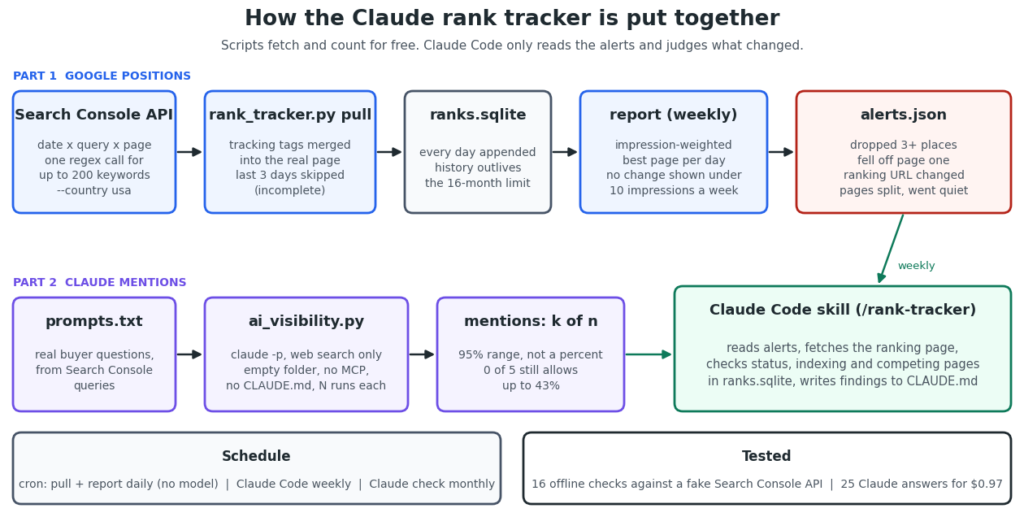
What is a Claude rank tracker? The phrase means two different things. Every result on page one of Google for “claude rank tracker” is a tool that tracks whether Claude mentions your brand in its answers. Many people searching it want something else: a way to track their Google rankings using Claude. This guide builds both in Claude Code, for free or close to it. Google positions come from the Search Console API. Claude visibility comes from asking Claude the same buyer questions several times and counting how often you appear.
I ran both on this blog before writing a word. The Google tracker pulled 90 days for 37 keywords in one API call. The Claude test asked five buyer questions five times each, cost $0.97 for all 25 answers, and found this blog in none of them. That result, and why “0 of 5” still allows a real mention rate up to 43%, is in the second half.
Key takeaways
- Track Google positions from Search Console, not a SERP database. Ahrefs had no stored results for either keyword I checked. Search Console had 90 days of daily data for both.
- Never read a daily position. On a keyword with about 4 impressions a day, the position moved 3 or more places on 34 of 68 consecutive days. Weekly, impression-weighted numbers with a minimum impression count are the honest unit.
- Filter by country. Only 15% of the impressions for one of my keywords came from the US, and the US position was 9.8 against 8.6 worldwide.
- Count Claude mentions across repeated answers, never one answer. Report “2 of 5” with a range, not a percentage.
- Run the scripts daily from cron for free, and let Claude Code investigate alerts once a week. The model is for judgment, not for fetching numbers.
Why “Claude rank tracker” means two different things
I found this keyword in my own Search Console data. Between September 5 and October 8, searches like “best online claude rank tracker” (69 impressions, position 4.8), “claude seo trackers” (45, position 3.2) and “best claude rank tracker tools” (44, position 6.1) showed my Claude SEO tools roundup near the top. It got zero clicks. Ahrefs puts “claude rank tracker” at about 200 searches a month in the US.
Then I looked at page one. On November 23, 2026, all eight organic results were products that track brand visibility inside Claude: dedicated “Claude rank tracker” pages from AI visibility vendors, a free checker and one roundup of Claude tracking tools. None was about tracking Google rankings with Claude. The guides that do cover building a tracker with Claude Code, the three I read, share two gaps: no working code on the page, and no check of how accurate the rank data is. So this guide covers both meanings, with code, tests and real results.
Part 1: Track Google rankings with Claude Code and Search Console
Why Search Console instead of a SERP tool
Commercial rank trackers check a search result page from one location at one moment. Search Console reports what your site actually got: every impression, the position it was shown at, and the click, for every query that reached a minimum volume. It is free, it is Google’s own data, and it covers keywords too small for any third-party database.
That last point is not theoretical. I asked the Ahrefs MCP server (serp-overview) for the results for “screaming frog mcp” and “information gain seo,” two keywords my posts rank for. It returned no stored results for either. Search Console had a row for every day of the last 90 for both.
What Search Console’s “position” actually is
Most rank tracking mistakes start here, so it is worth the detail. From Google’s Search Console documentation:
- It is your topmost position, averaged. If two of your pages show for one search, the higher one counts, and the number is averaged across every search your site appeared in. A day with 3 impressions moves the average as much as noise does.
- An AI Overview is one position. Google’s wording: “all links in the AI Overview are assigned that same position.” A page cited in an Overview near the top of the page can show a much better average position than its regular listing, without any more clicks.
- The last two or three days are incomplete. The tracker stops three days before today.
One live check shows why this matters. When I searched “screaming frog mcp” myself on November 23, my post was the fifth result on page two, the 12th regular result counting from the top. Google’s own Search Console panel on that same results page showed my average position as 8.7. Neither number is wrong. Search Console averages every searcher, day and location and counts result blocks its own way. My one search was one sample from Vancouver, WA. If a client asks why their tracker and Search Console disagree, that is the answer.
How noisy are daily positions?
I measured it on 90 days of my own data, taking the site’s best position per day:
| Keyword | Median impressions per day | Daily position range | Days that moved 3+ places | Spread, daily vs weekly (standard deviation) |
|---|---|---|---|---|
| screaming frog mcp | 13 | 6.0 to 11.7 | 2 of 88 | 0.9 vs 0.4 |
| information gain seo | 4 | 8.0 to 28.0 | 34 of 68 | 3.5 vs 2.2 |
On the smaller keyword, half of all day-to-day changes were 3 places or more. A daily email built on that would cry wolf three or four times a week. So the tracker never reports a single day: it compares this week with last week, weights by impressions, and shows no change at all when either week has fewer than 10 impressions.
Filter by country, or the average lies
Search Console mixes every country together unless you filter. For “screaming frog mcp” only 202 of 1,353 impressions (15%) came from the US, and the US position was 9.8 against 8.6 overall. For “information gain seo” the US share was 68%. A local business tracking a worldwide average is tracking traffic it does not serve. The tracker takes --country usa (Search Console uses three-letter country codes).
The tracker: one script, one API call
rank_tracker.py uses only Python’s standard library and a read-only Search Console token. If you set up the token for my AI SEO agent, it is the same one. It has three commands:
# 1. suggest keywords from your real Search Console queries
python3 scripts/rank_tracker.py suggest --site https://example.com/ --quota-project my-project

# 2. pull 30 days for your tracked keywords (daily)
python3 scripts/rank_tracker.py pull --site https://example.com/ --keywords keywords.txt \
  --country usa --quota-project my-project

# 3. weekly report and alerts
python3 scripts/rank_tracker.py report --keywords keywords.txt
Three design choices do most of the work:
- One call for every keyword. The Search Console API accepts a regular expression filter on queries, so the tracker sends one exact-match pattern for up to 200 keywords and asks for date, query and page together. My 37 keywords came back as 1,425 rows from a single request.
- History in SQLite. Search Console keeps 16 months. The tracker appends to a local
ranks.sqlitefile, so history keeps growing and survives that limit. - Tracking tags merged. Google Business Profile links often arrive with
?utm_source=tags and show up as separate pages. The tracker folds them into the real page before comparing anything.
The alerts, and what my first report found
The weekly report writes report.md (a table) and alerts.json. Five alerts are worth a person’s attention:
| Alert | Rule | What to check |
|---|---|---|
| dropped | Lost 3 or more places week over week, with at least 10 impressions both weeks | Is the page still indexable and unchanged? Did another of your pages take the keyword? |
| fell_off_page_one | Was 10 or better, now worse than 10 | Same, plus what newly outranks you |
| ranking_url_changed | A different page now gets most of the keyword’s impressions | Which page should own the keyword |
| pages_split | No single page gets 60% of the impressions | Two pages answering one search: merge or separate |
| went_quiet | Had impressions last week, none this week | Whether the page still exists and is indexed |
On this blog, the week ending November 20 had 24 of 37 tracked keywords with data and one alert: “salient seo” dropped from 31.0 to 34.1. The report also showed most of the information gain keywords sitting between positions 19 and 24, which is part of why I rewrote my information gain post the same day. And it showed the “claude rank tracker” searches from September had gone quiet, which is part of why this post exists.
Let Claude Code investigate, not fetch
The scripts produce numbers. The Claude Code skill (SKILL.md in the kit) turns alerts into findings. For each alert it fetches the ranking page and checks status, indexability and content, looks up which of your other pages show for the same keyword in ranks.sqlite, and writes what it found and what it recommends under ## Rank tracking log in your CLAUDE.md, keeping the last eight entries. It never reports a daily position, and it never calls a change real when either week was below the impression minimum.
Part 2: Track how often Claude mentions you
This is what the tools on page one sell. You can measure it yourself, and the method matters more than the tool.
One answer tells you almost nothing
Claude’s answers change from run to run, so the unit is “mentioned in k of n answers,” and n has to be stated. With 5 answers and 0 mentions, the 95% range for the real mention rate runs from 0% to 43%. With 5 of 5 it runs from 57% to 100%. Twenty answers narrow it a lot. A dashboard that shows “Claude visibility: 0%” from a handful of checks is showing noise with a percent sign.
The script
ai_visibility.py asks each prompt N times through Claude Code’s headless mode with only web search and web fetch allowed:
python3 scripts/ai_visibility.py --prompts prompts.txt \
  --brand "Acme Plumbing,acmeplumbing" --domain acmeplumbing.com \
  --competitors "competitor1.com,competitor2.com" --runs 5
Each run starts in an empty folder with no CLAUDE.md, no user settings, no hooks and no MCP servers, so your own setup does not leak into the answer. Every answer is saved to ai-visibility.jsonl for audit. The table counts mentions of your brand, citations of your domain and your competitors’ domains, and the sources Claude used most. Placeholder domains from code samples, such as example.com, are ignored. The first version counted them.
What happened on this blog
Five buyer questions this blog has posts for, five answers each, Claude Sonnet with web search, November 23, 2026:
| Prompt | Mentioned this blog | Sources cited in every answer | Answers with no sources listed |
|---|---|---|---|
| How do I connect Screaming Frog to Claude? | 0 of 5 | screamingfrog.co.uk, github.com, pypi.org | 0 |
| How do I build an SEO agent in Claude Code? | 0 of 5 | none | 3 |
| What is information gain in SEO and how do I calculate an information gain score? | 0 of 5 | none | 3 |
| What are the best Claude Code skills for SEO? | 0 of 5 | seven, mostly skill directories and GitHub | 0 |
| How can I track my keyword rankings with Claude Code? | 0 of 5 | keyword.com, mcpservers.org | 0 |
Three things stand out. First, 0 of 25 is a real result for this blog, and it is also consistent with a low mention rate the sample cannot see. More runs over more weeks will tell. Second, when Claude searches, it is consistent about where it looks: for three of the five questions, the same sources came up in all five answers. Those sources are the pages to study, and they were mostly official pages, GitHub, package registries and directories rather than blogs. Third, for two of the questions Claude answered three times out of five without listing any sources, which suggests it often answered from what it already knew. Being cited for a “how” question means adding what its built-in knowledge lacks, which is the case my information gain guide makes. My older post on getting mentioned in Claude covers the content side.
Cost and time, as reported by Claude Code: $0.97 for all 25 answers, a median of 18 seconds each.
What this measures, and what it does not
- It measures Claude with web search as Claude Code runs it. The Claude app has its own system prompt and may answer differently.
- Asking for sources at the end of the prompt is a small change to the question. It is the same change every run, so changes over time still compare.
- It cannot see other users’ conversations or how often real people ask your questions. Pick prompts that match real buyer questions, such as Search Console queries phrased as questions.
How to schedule it
The cheapest setup that works: the scripts run every morning from cron with no model involved, and Claude Code runs once a week to investigate the alerts.
0 7 * * *  cd ~/rank-tracking && python3 scripts/rank_tracker.py pull ... && python3 scripts/rank_tracker.py report ...
0 8 * * 1  cd ~/rank-tracking && claude -p "/rank-tracker investigate this week's alerts" \
             --permission-mode dontAsk --allowedTools Bash Read Write Edit WebFetch
0 9 1 * *  cd ~/rank-tracking && python3 scripts/ai_visibility.py --prompts prompts.txt ... --runs 5
Inside an open Claude Code session, /loop 1d /rank-tracker does the same for as long as the session stays open. My AI SEO agent guide covers running Claude Code headless on a schedule, including how to limit its tools and budget.
What it costs compared with a rank tracking tool
| Part | Cost | Limits |
|---|---|---|
| Google positions from Search Console | Free | Your own site only; keywords you already get impressions for |
| Weekly investigation in Claude Code | Your Claude plan | Only runs when there are alerts worth reading |
| Claude visibility, 5 prompts x 5 runs | $0.97 per check as reported by Claude Code | Claude only; other assistants need their own runs |
What you give up compared with a paid tracker: positions for keywords you do not rank for yet, competitors’ positions, and city-level checks for local SEO. If you need those, a SERP API or a paid tracker earns its fee. For “where does my own site stand, and what changed,” Search Console is the better source, because it is the record rather than a sample.
How I tested it
The kit includes offline tests (python3 tests/test_tracker.py, 16 checks, a few seconds, no account needed). They run the tracker against a fake Search Console API and check that it sends one exact-match regex and the country filter, that each alert fires on the case it is for, that a steady keyword raises nothing, that a 17-place jump on too few impressions raises nothing, that tracking tags merge, that keywords with no data are listed rather than dropped, and that the mention-rate ranges and the source parser are right.
Frequently asked questions
What is the best rank tracker tool?
For your own site’s Google positions, Search Console’s data is the most accurate source there is, and the free tracker in this guide makes it usable week to week. Paid trackers are better when you need competitors’ positions, keywords you do not rank for yet or city-level local results.
How does Claude rank sources?
Claude does not publish a ranking. In my tests, when it searched the web it went back to the same few sources across repeated answers, mostly official pages, GitHub, package registries and directories, and for some questions it answered without listing any sources. Repeated runs show which sources it relies on.
How do you track keyword rankings?
Pick keywords from your Search Console queries, pull daily date, query and page data with the API, store it, and compare impression-weighted weekly positions with a minimum impression count. Filter by the country you serve, and investigate drops before reporting them.
What is a free tool that can check my website ranking?
Google Search Console is free and shows the average position for every query your site appears for. The script in this guide adds what the interface lacks: tracked keyword lists, history beyond 16 months, weekly comparisons and alerts.
Can Claude track my Google rankings?
Claude Code can, by running a script that pulls Search Console data and then investigating what changed. Claude on its own cannot see your rankings, and asking it to search Google for your position gives one unreliable sample.
How accurate is Search Console average position?
It is accurate as an average of what your site was shown at, weighted by impressions, using your topmost result. It will not match a single manual search, it counts an AI Overview as one position, and on low-impression keywords it swings from day to day. Use weekly numbers with a minimum impression count.
How do I track whether Claude mentions my brand?
Ask Claude the same buyer questions several times with web search on, count the answers that mention you, and report the count with a range. Five runs per question is a starting point. Repeat monthly, because one check cannot separate a change from noise.
Download the Claude rank tracker
The kit is free and MIT licensed: rank_tracker.py, ai_visibility.py, the Claude Code skill and the offline tests. Put it in ~/.claude/skills/rank-tracker/ and run /rank-tracker from any project.
Download the Claude rank tracker (zip)
For the rest of the stack, my guide to Claude for SEO covers setup, and the Screaming Frog MCP guide adds a crawler.