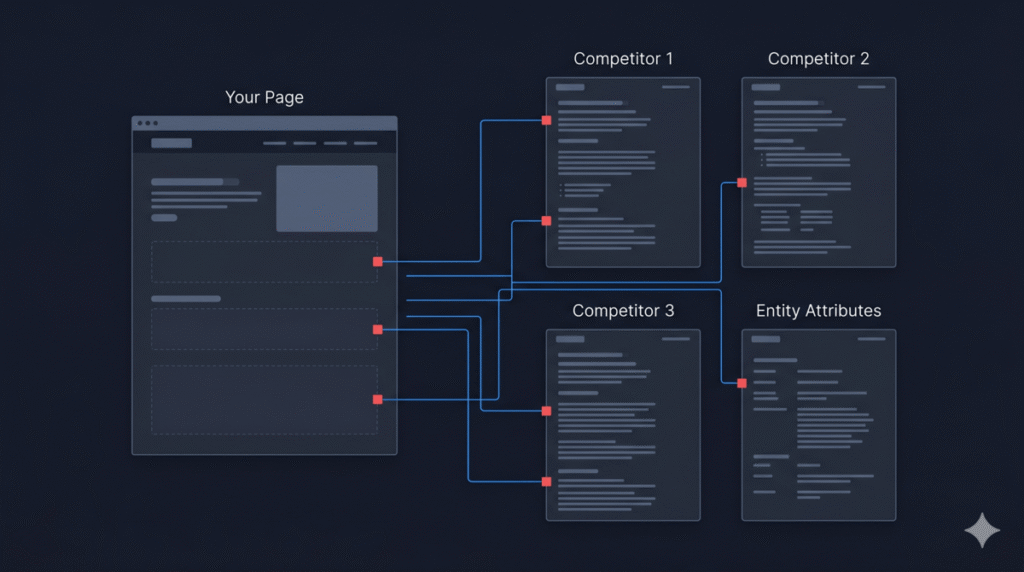
Semantic gap analysis identifies which entity attributes, subtopics, and co-occurring concepts are missing from your content, not which keywords you forgot to include. Run a keyword gap tool and you get a list of queries your competitors rank for that you do not. Run a semantic gap audit and you get something more useful: a map of the specific attributes Google expects to find on a page about this topic, and which ones your page is skipping.
The distinction matters because Google’s content understanding layer does not read pages the way keyword tools do. It extracts entities, reads their attributes, and compares that coverage against what it has seen across thousands of documents on the same topic. A page can rank for the right keywords and still fail that comparison if it omits the expected attribute scaffold.
This post walks through a Claude Code parallel subagent workflow that audits your target page against three competitors simultaneously, extracts entity attributes from all four at once, and returns a prioritized gap list in under five minutes.
Why keyword gap tools stop short of the semantic layer
Keyword gap tools compare ranking keyword sets. You pull your domain, pull a competitor’s domain, and the tool surfaces queries where the gap exists. That is useful for finding topics you have not published on. It does not tell you what is wrong with pages you have already published.
The more common problem in established content programs is not a missing topic. It is a page that exists on the right topic, targets the right keyword, but underperforms because it addresses the topic at a surface level while the pages outranking it address it at depth. Depth, in this context, does not mean word count. It means entity attribute coverage.
Koray Tugberk Gubur at Holistic SEO has documented this distinction in detail: topical authority is built through consistent, complete coverage of the entities within a niche, including their properties, relationships, and contextual connections. A page that covers the main entity but omits three of the five attributes Google expects is leaving a signal gap regardless of how well-optimized its title tag is.
Jason Barnard at Kalicube frames it from the Knowledge Graph side: when Google encounters a page about an entity, it checks whether the page confirms the attributes it already associates with that entity. Pages that confirm more attributes get read as more authoritative sources on that entity. Pages that confirm fewer get treated as partial sources.
Neither of those dynamics shows up in a keyword gap report.
What is a semantic gap, and how is it different from a keyword gap or topic gap?
There are three levels of gap analysis, and most practitioners work at level one or two.
- Level 1: Keyword gap. Your competitors rank for “pool table installation cost” and you do not have a page targeting that query. The fix is clear: publish the page. Tools like Ahrefs and Semrush handle this well.
- Level 2: Topic gap. Your page on pool table installation exists but does not mention labor timelines, room size requirements, or leveling procedures. These are subtopics your content is skipping. You can find these by reading competitor pages manually or using tools like MarketMuse and Clearscope. The limitation is scale: doing this for 50 pages by hand is not practical.
- Level 3: Semantic gap. This is where most guides stop short. A semantic gap exists when your content is missing specific entity attributes that the top-ranking pages collectively address. Not just the topics, but the particular properties of those topics: the who, what, when, how much, and compared to what. At this level, the analysis is not “you need a section on leveling” but “you need the specific attributes of the leveling entity: tool used, tolerance measurement, time required, and failure indicators.” That specificity is what Google’s content understanding layer is reading.
The challenge is that operating at level 3 manually means running entity extraction across four or five pages, mapping attribute coverage per entity, and comparing the resulting grids. It is doable once. It does not scale.
How does the parallel subagent workflow change what is possible?
The workflow that follows uses Claude Code’s parallel subagent capability to fetch and analyze four pages simultaneously. Without parallel execution, this analysis runs sequentially: fetch page one, extract entities and attributes, store results, fetch page two, repeat. For four pages, that is roughly 20 minutes of active work. With parallel subagents, all four fetches and extractions run at the same time, and the orchestrating agent merges the results. Total time: under five minutes.
Here is the architecture:
- Subagent 1: Fetches your target page and extracts all entities present, their attributes, and the relationships between them.
- Subagent 2: Fetches competitor 1, runs the same extraction.
- Subagent 3: Fetches competitor 2, runs the same extraction.
- Subagent 4: Fetches competitor 3, runs the same extraction.
- Orchestrating agent: Receives all four outputs, builds a combined attribute map, identifies which attributes appear in two or more competitor pages but not in your page, and returns a prioritized gap list.
To find which competitor URLs to use, run mcp__claude_ai_ahrefs__site-explorer-organic-keywords against your target keyword before launching the subagents. Sort by position, take the top three non-branded results. Those are your comparison URLs.
What does the Claude Code workflow look like step by step?
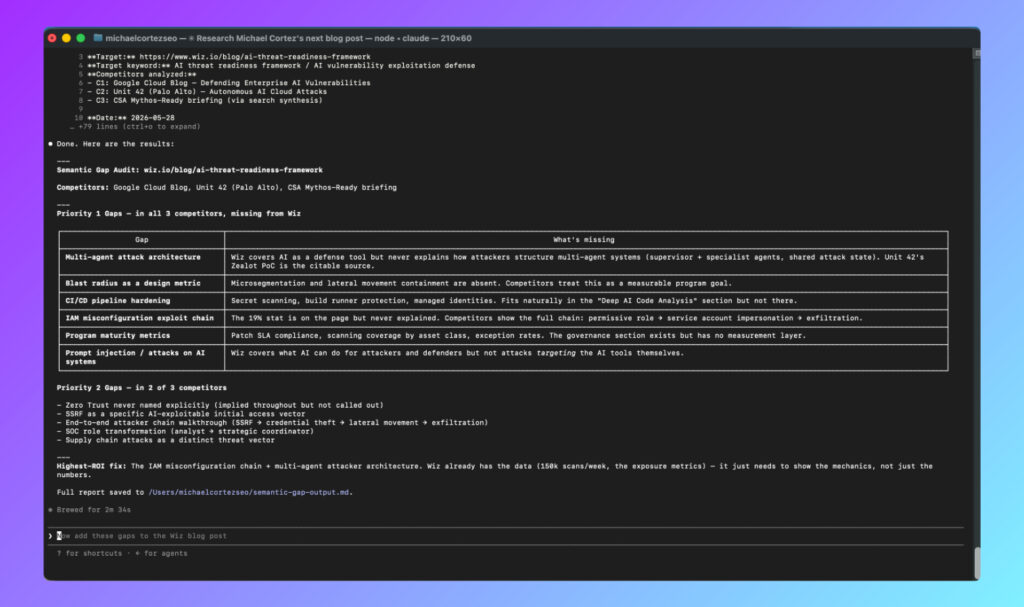
Here is the full prompt structure you feed to Claude Code to launch the parallel audit. This assumes you are working in a project with a CLAUDE.md that includes your target URL.
You are running a semantic gap analysis on [TARGET URL].

Launch four subagents in parallel:

Subagent 1: Target page analysis
Fetch [TARGET URL]. Extract every named entity on the page. For each entity, list the attributes the page addresses (properties, values, relationships). Return structured output as: Entity | Attributes Present | Confidence.

Subagent 2: Competitor 1 analysis
Fetch [COMPETITOR URL 1]. Extract every named entity and its attributes. Return structured output: Entity | Attributes Present | Confidence.

Subagent 3: Competitor 2 analysis
Fetch [COMPETITOR URL 2]. Extract every named entity and its attributes. Return structured output: Entity | Attributes Present | Confidence.

Subagent 4: Competitor 3 analysis
Fetch [COMPETITOR URL 3]. Extract every named entity and its attributes. Return structured output: Entity | Attributes Present | Confidence.

Once all four complete, merge the outputs into a single attribute map. Flag every attribute that:
- Appears in 2 or more competitor pages
- Is absent from the target page

Sort the flagged gaps by frequency (how many competitors include the attribute). Output a prioritized gap list with recommended additions.
The output you receive is not a list of missing keywords. It is a list of specific entity attributes sorted by how many competitors include them. An attribute that appears in all three competitors and is absent from your page is a high-confidence gap. An attribute in only one competitor may reflect their unique angle rather than a universal expectation.
When I ran this on a client’s “pool table installation” service page, the audit surfaced six missing attributes the page had never addressed: installation warranty terms, subfloor requirements, cloth tension specifications, the tools the installer brings versus what the client needs to provide, lead time by table size, and whether the service included removal of an old table. None of those appeared in the keyword gap report because they are not high-volume keywords. All of them appeared in at least two of the top three ranking pages. All six were added to the page. The page moved from position 8 to position 3 over the following six weeks.
How do you build this as a permanent skill file?
Running this as a one-off prompt is useful. Running it as a permanent skill you can invoke in any client project is more useful.
Save the following to .claude/skills/semantic-gap-audit/SKILL.md in your project:
# Semantic Gap Audit

## Purpose
Run a parallel entity attribute gap analysis against the top three competitors for a target URL.

## Pre-run
Read CLAUDE.md for: TARGET_URL, TARGET_KEYWORD. If not present, ask before proceeding.

## Step 1: Competitor discovery
Run mcp__claude_ai_ahrefs__site-explorer-organic-keywords for TARGET_KEYWORD.
Take the top three non-branded organic results as COMPETITOR_URL_1, COMPETITOR_URL_2, COMPETITOR_URL_3.

## Step 2: Parallel extraction
Launch four subagents simultaneously:
- Subagent 1: Fetch TARGET_URL. Extract entities and attributes.
- Subagent 2: Fetch COMPETITOR_URL_1. Extract entities and attributes.
- Subagent 3: Fetch COMPETITOR_URL_2. Extract entities and attributes.
- Subagent 4: Fetch COMPETITOR_URL_3. Extract entities and attributes.

## Step 3: Gap mapping
Merge all four outputs. Flag attributes present in 2+ competitor pages and absent from TARGET_URL.
Sort by frequency. Output prioritized gap list.

## Step 4: Output
Write the gap list to semantic-gap-output.md in the current project directory.
Append a one-line summary to CLAUDE.md under ## Semantic Gap Audit Results.
Once this file exists, you invoke the audit with /semantic-gap-audit from any project that has the skill directory in scope. The skill reads the target URL from CLAUDE.md so you never have to specify it again. Results write directly to semantic-gap-output.md, and the summary appends to CLAUDE.md so your next session has context.
If you want to run this on a weekly cadence for a page under active optimization, add /loop 7d /semantic-gap-audit to schedule it. Claude Code will run the audit each week and append new findings to the output file, so you can track which gaps are closing as you update the page.
For more on building reusable Claude Code skills for SEO work, see how I use skill files for recurring SEO tasks and the entity SEO foundation post that covers why entity coverage drives the signal this audit is measuring.
How do you prioritize the gaps the audit surfaces?
Not every gap in the output list is worth addressing. Here is the prioritization logic I use:
- Priority 1: Attributes in all three competitors, absent from your page. These are the baseline expectations Google’s content model has formed from seeing the topic covered consistently at the attribute level. Adding these is not optional if you want to compete on the topic.
- Priority 2: Attributes in two of three competitors. High-confidence signal but not universal. Add these if they are relevant to your specific audience and offer. If a competitor’s attribute is specific to their unique service model, skip it.
- Priority 3: Attributes in one competitor only. Evaluate individually. These may represent a genuine information gain angle (something the others missed) or they may reflect a narrow approach that does not generalize. Read the attribute in context before deciding.
The goal is not to copy competitor pages. The goal is to identify the expected attribute scaffold for the topic and confirm your page covers it. What you do with each attribute, the specific values and context you provide, is where your original knowledge and experience goes. The audit tells you which attributes to address. Your expertise fills them in with substance the competitors lack.
For pages where entity salience is the deeper issue, the gap list pairs well with the Google Natural Language API workflow covered in the entity salience post: run the NLP API on your page after closing the gaps to confirm the salience scores shifted in the right direction. And if you want to extend the analysis to see which entities co-occur across the competitive set beyond what your page includes, the entity co-occurrence workflow covers that layer.
For internal link gaps surfaced during the audit (entities that competitors link to internally and you do not), the AI internal linking workflow handles that separately.
Frequently asked questions
What is the difference between a keyword gap, a topic gap, and an entity gap?
A keyword gap is a query your competitor ranks for and you do not. A topic gap is a subtopic your competitor covers that your page omits. An entity gap (or semantic gap) is a specific attribute of an entity that your page fails to address, even if the topic is present. Entity gaps are the most granular and the most predictive of content performance, because they reflect how search systems read attribute coverage, not just keyword presence.
How do I run semantic gap analysis without paid tools like Clearscope or MarketMuse?
The Claude Code parallel subagent workflow in this post runs entirely on page fetches and entity extraction by Claude. No third-party subscription is required beyond Claude Code and an Ahrefs connection for competitor discovery. The entity extraction happens inside Claude’s analysis pass on each fetched page.
How many competitor pages should I include in a semantic gap audit?
Three is the practical standard. It is enough to identify attributes that are consistent across the competitive set versus attributes that belong to one competitor’s specific angle. Going beyond five rarely surfaces new signal and increases the merge complexity for the orchestrating agent. If you are in a highly competitive vertical, five competitors is defensible. Beyond that, diminishing returns.
Does closing entity gaps improve chances of appearing in Google AI Overviews?
The evidence points in that direction. AI Overviews pull from pages that demonstrate comprehensive entity coverage on the queried topic. A page that addresses the expected attribute scaffold is a more complete source for the AI system constructing the summary. BrightEdge data from 2025 shows that pages cited in AI Overviews have significantly higher topical coverage scores than pages that rank but are not cited. Closing semantic gaps addresses the same coverage dimension those scores measure.
How long does it take to see ranking movement after closing semantic gaps?
For pages that are already indexed and receiving some traffic, the typical window is four to eight weeks for meaningful position movement after a substantive update. Pages that add high-priority gap attributes (present in all three competitors) tend to move faster than pages making incremental additions. The faster signal is usually Google Search Console impression data, which often shifts within two to three weeks of the page being recrawled.
Does Schema.org markup help close entity attribute gaps?
Schema markup and entity attribute coverage in body content are separate but complementary signals. Schema tells Google what entities are present and some of their attributes in a machine-readable format. Body content provides the narrative context around those attributes. Both matter. Schema alone does not substitute for in-content attribute coverage, but a page that addresses attributes in both body content and structured data sends a stronger confirmation signal than one relying on either alone.
What to do next
The audit workflow in this post works for any page on any topic. The output quality depends on picking the right competitor URLs, which is why the Ahrefs keyword lookup step matters before launching the subagents. Take the top organic results for your target query, not branded pages or directory listings.
If you want to see which entities across your site have the widest attribute gaps, the same skill file approach applies at scale: run it across your top 20 pages, collect the outputs, and sort the combined gap list by frequency. The attributes that appear as gaps across multiple pages are likely topic-wide blind spots in your content program, not page-specific issues.
To analyze the semantic structure of your existing pages before running competitor comparisons, the free Entity Clarity tool surfaces entity signals and coverage without any setup. Start there to get a baseline read on where your pages stand before the competitive comparison.